+852 5394 6901
 Take China Group Tours in 2026/2027 to enjoy 30% discount compared to private tour. Same Experience & Lowest Price!

What Are Hutongs?
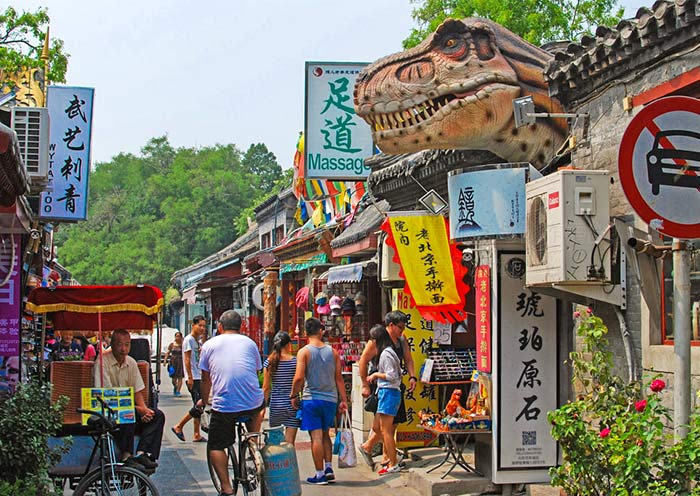
Hutongs are unique to Beijing and other northern Chinese cities, offering a deep dive into a long history and rich cultural background.
These narrow streets, usually squeezed between courtyard residences known as "siheyuan," form the foundational layout of old Beijing. Today, there are over 1,000 hutongs in the city.
What's so Special about Hutongs?
Well, they're super narrow – some are only a few feet wide! And they're usually filled with these traditional courtyard houses called siheyuan. These houses are built around a central courtyard and have a really unique layout.
From above, the hutongs look like a maze or a giant chessboard, with all these little lanes crisscrossing each other.
A Bit of History of Hutong
Hutongs have been around for over 700 years! They really took off during the Ming and Qing dynasties. Back then, almost everyone in Beijing lived in a hutong.
Today, many hutongs have been turned into tourist spots, but you can still find plenty where people live their everyday lives.
Why are hutongs so popular?
It's all about the vibe. They offer a glimpse into traditional culture of China and a sense of community that's hard to find in big cities. Imagine hanging out with your neighbors in the courtyard, chatting and laughing. That's the kind of atmosphere you'll find in a hutong.
The Names are Cool too
Some hutongs are named after directions (like East Jiao Min Alley), others after famous people (like Shijia Hutong), and some even after the things people used to do there (like Hat Alley).
Where Are the Hutongs in Beijing? Beijing Hutong Area Map & Neighborhoods
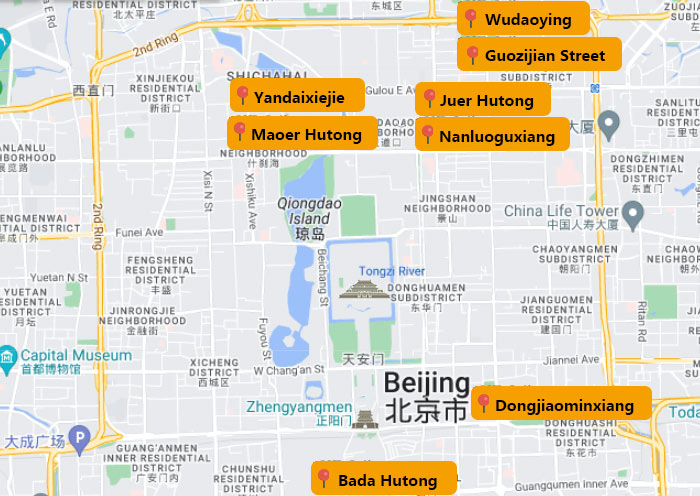
Beijing's hutongs cluster inside the Second Ring Road, which traces the path of the former city walls. They concentrate around the Forbidden City in four main neighborhoods.
All four areas are within 3–4 km of each other — easily walkable or connected by a short metro ride on Lines 2, 5, 6, and 8.
| Neighborhood | Location | Character | Key Hutongs |
|---|---|---|---|
| Nanluoguxiang / Yonghegong | Northeast of Forbidden City | Most popular with visitors; mix of commercial and residential | Nanluoguxiang, Wudaoying, Guozijian Street, Mao'er, Ju'er |
| Shichahai / Houhai | Northwest of Forbidden City | Scenic lakeside setting; rickshaw rides and bars | Yandai Xiejie, lanes around Qianhai and Houhai lakes |
| Dashilar / Qianmen | South of Forbidden City | Merchant history; creative revival; grittier atmosphere | Yangmeizhu Xiejie, Liulichang, Bada Hutong |
| Dongsi | East of Forbidden City | Quiet residential; best-preserved architecture; few tourists | Dongsi Santiao–Batiao, Shijia Hutong |
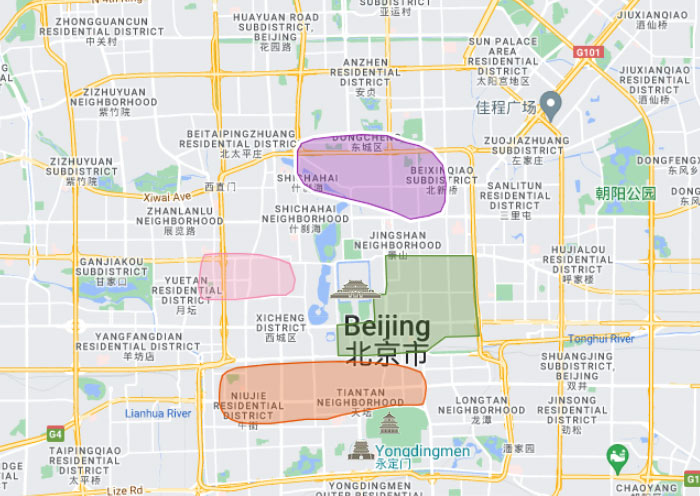
Dongcheng District: Yonghegong Area
Located to the north of the Forbidden City, Dongcheng is often the first place people think of when hutongs come to mind. It is one of the most popular hutong destinations in Beijing.
As you wander away from the main alleys, you'll find yourself in residential hutongs where life slows down, and everything feels more authentic.
Notable hutongs in this area include Nanluoguxiang, Guozijian Street, Mao'er Hutong, Yandai Xiejie, Juer Hutong, Wudaoying Hutong, and the Shichahai area.
Dashilar Area
Situated to the south of the Forbidden City, Dashilar is another hotspot for experiencing the hutongs in Beijing. This area is rich in history and bustling with local life.
Key hutongs to explore here include Shi Jia Hutong, Zhu Jia Hutong, Dongnan Yuan Hutong, Xingsheng Hutong, Liulichang Cultural Street, Yanzi Hutong, Guantong Alley, and Jiuwan Hutong.
Fengsheng Area
To the west of the Forbidden City, the Fengsheng area was once among the wealthiest parts of Beijing and retains a touch of its former grandeur. Important hutongs here include Fengsheng Hutong, Xianming Hutong, and Lingjing Hutong.
Qianmen Street
On the east side of the Forbidden City, Qianmen Street was historically considered a privileged residential area and later utilized for embassies, customs houses, and foreign concessions.
Noteworthy hutongs in this district include Dongjiaomin Alley, Jinyu Hutong, and Beiwazi Hutong.
If you only have half a day, focus on the Nanluoguxiang/Shichahai area. If you have a full day, add the Dongsi area for a more authentic, crowd-free contrast.
12 Best Hutongs in Beijing: Which Hutongs Should You Visit?
| Hutong | Vibe | Crowd Level | Must-See Highlight |
|---|---|---|---|
| Nanluoguxiang | Bustling, commercial | High | Side alleys off the main lane |
| Wudaoying | Trendy, relaxed | Low–Medium | Independent courtyard cafés |
| Yandai Xiejie | Picturesque, traditional | Medium | Silver Ingot Bridge lake view |
| Guozijian Street | Scholarly, quiet | Low | Confucius Temple & paifang arches |
| Mao'er Hutong | Historic, grand | Low | Wanrong's bridal residence |
| Ju'er Hutong | Architectural, residential | Low | UN-awarded courtyard design |
| Shijia Hutong | Cultural, museum-focused | Low | Shijia Hutong Museum (free) |
| Yangmeizhu Xiejie | Creative, curated | Low–Medium | Independent bookshops & studios |
| Dongsi Cluster | Authentic residential | Very Low | Untouched courtyard gates |
| Dongjiaominxiang | European, historical | Low | Western architecture |
| Liulichang | Scholarly, artistic | Low–Medium | 350-year-old Rongbaozhai art shop |
| Bada Hutong | Raw, unpolished | Very Low | Ornate Qing-era facades |
If this is your first time in Beijing, the easiest and most rewarding route is to combine Nanluoguxiang, nearby side alleys such as Ju’er Hutong and Mao’er Hutong, and then continue to Shichahai or Guozijian Street depending on your interests.
1. Nanluoguxiang (南锣鼓巷) — Beijing's Most Famous Hutong
Metro: Nanluoguxiang (Lines 6 & 8)
Time: 5–2 hrs
Best for: First-time visitors, street food, shopping
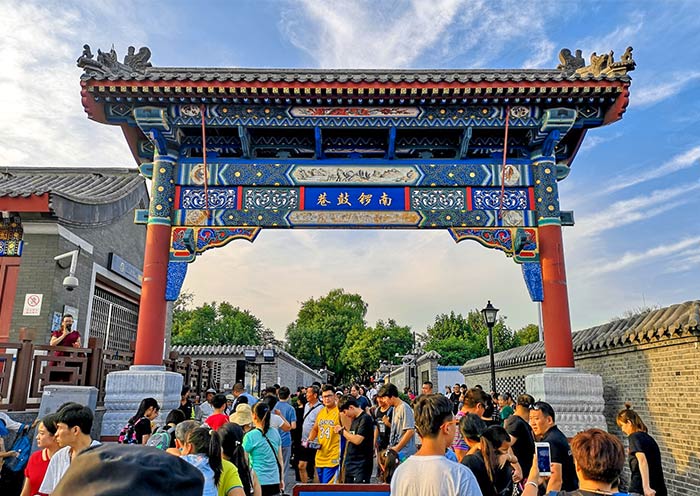
Nanluoguxiang is one of the oldest hutongs in Beijing, preserving a well-maintained layout from the Yuan Dynasty, with a history spanning over 740 years.
The main street stretches 787 meters, flanked by eight smaller alleys, including the famous Juer Hutong and Mao'er Hutong. Many notable figures have resided here.
As one of Beijing's most popular hutongs, Nanluoguxiang is a haven for food lovers and the curious alike.
Unlike large shopping malls, this area is filled with small shops offering a variety of souvenirs and traditional Chinese handicrafts. The array of Chinese and international restaurants satisfies many a food enthusiast.
Here, you can also experience authentic Beijing culture by taking a ride in a rickshaw, adding to the charm and historical richness of Nanluoguxiang.
2. Wudaoying Hutong (五道营胡同) — The Trendiest Lane
Metro: Yonghegong (Lines 2 & 5)
Time: 1–1.5 hrs
Best for: Cafés, independent shops, relaxed vibe
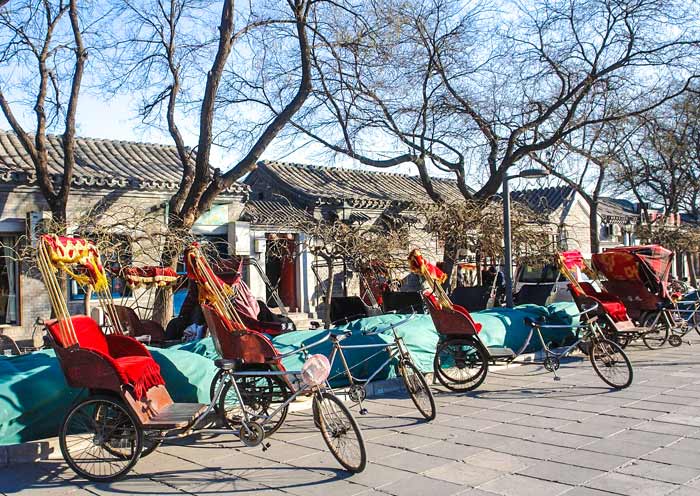
Running parallel to the Lama Temple's south wall, Wudaoying has evolved from a quiet residential lane into one of Beijing's coolest streets: independent coffee roasters, craft beer bars, vintage shops, ceramics studios, and small galleries, all in converted courtyard spaces.
The foot traffic is lighter than Nanluoguxiang and the businesses tend to be owner-operated.
Its proximity to both the Lama Temple and the Confucius Temple makes it a natural café stop between two major cultural sites.
3. Yandai Xiejie (烟袋斜街) — The Pipe-Shaped Lane
Metro: Shichahai (Line 8)
Time: 30–45 min
Best for: Photography, atmosphere, connecting to Houhai Lake
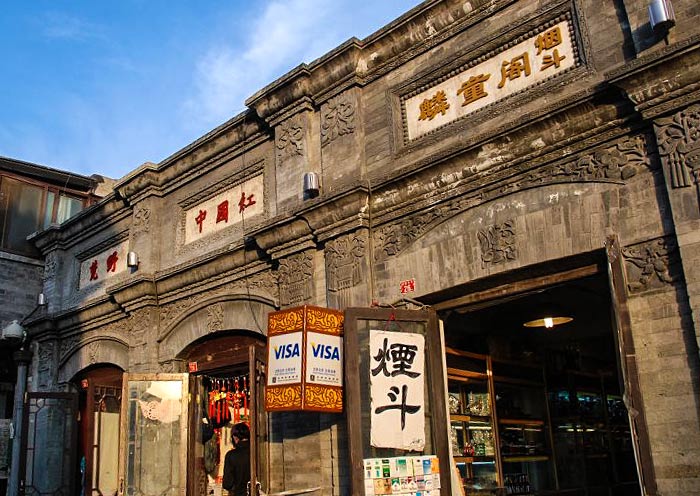
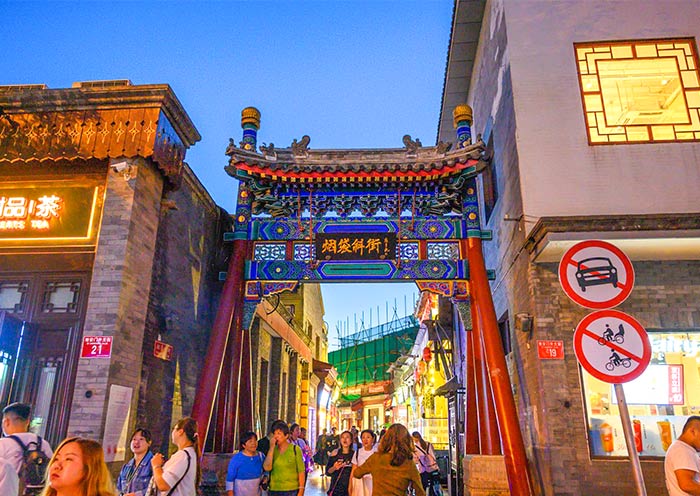
Yandai Xiejie, located near Shichahai and Houhai in the Xicheng District, is one of the oldest commercial streets of Beijing.
Its name, which reflects its past as a center for manufacturing and selling smoking pipes during the Qing Dynasty, hints at its historical significance. The street is laid out in a northeast-southwest direction, mimicking the shape of a traditional smoking pipe.
One of the highlights of Yandai Xiejie is its preservation of the features typical of Beijing's civilian streets, such as shops with wooden structures, walls of grey bricks and tiles, and charmingly antique decorations.
These elements provide a perfect backdrop for capturing captivating photos of old Beijing.
The Silver Ingot Bridge (Yinding Qiao) at the western end, with views across Houhai and Qianhai lakes; traditional paper-cutting and calligraphy shops.
4. Guozijian Street (国子监街) — The Ancient Academic Avenue
Metro: Yonghegong (Lines 2 & 5)
Time: 1–1.5 hrs
Best for: History, Confucian heritage, quiet atmosphere
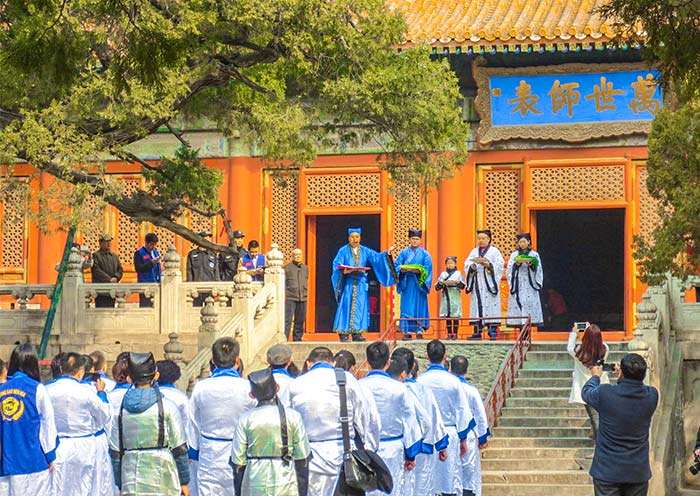
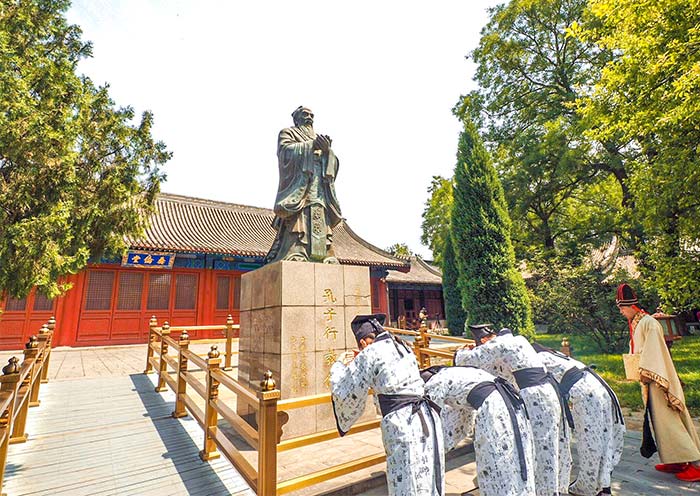
Guozijian Street, or Imperial College Street, this historic alleyway was once the site of the Imperial College, The first national university of China. Today, the street is lined with traditional courtyard houses, ancient temples, and cultural institutions.
Visitors can explore the Confucian Temple, the Imperial College, and the Wenchang Pavilion, which were all important centers of learning and education in ancient China. Guozijian Street offers a glimpse into the rich educational history and cultural heritage of Beijing.
The 700-year-old cypress tree in the Confucius Temple courtyard; Emperor Qianlong's calligraphy stele pavilion.
5. Mao'er Hutong (帽儿胡同) — Where Royalty and Warlords Lived
Metro: Nanluoguxiang (Lines 6 & 8)
Time: 30–45 min
Best for: Historic residences, architecture
Mao'er Hutong, which literally means "Hat Alley," is a famous old street in Beijing that runs from Di'anmen Outer Street all the way to the Jiao Dao Kou area. It's a great place to check out if you're interested in history and traditional Chinese architecture.
The street is known for its well-preserved historic houses, including the former home of the last Empress of China, Wanrong (at numbers 35 and 37), and the mansion of the powerful warlord Feng Guozhang (at number 11).
6. Ju'er Hutong (菊儿胡同) — Award-Winning Architectural Innovation
Metro: Nanluoguxiang (Lines 6 & 8)
Time: 20–30 min
Best for: Architecture, urban design
Ju'er Hutong is famous for being the home of many important people in Chinese history. Ronglu, a powerful official during the Qing Dynasty who was favored by Empress Dowager Cixi, lived in houses number 3, 5, and 7.
What's really cool about Ju'er Hutong is its unique design. In the early 1990s, architect Wu Liangyong led a team to renovate the hutong, combining traditional courtyard houses with modern design.
Their work was so impressive that it won a UN award for human settlements!
Comparing the 1990s renovation with the older traditional sections; Ronglu's former residence (No. 3, 5, 7), a powerful Qing official favored by Empress Dowager Cixi.
7. Shijia Hutong (史家胡同) — Home to Beijing's Best Hutong Museum
Metro: Dengshikou (Line 5) or Dongsi (Lines 5 & 6)
Time: 1–1.5 hrs
Best for: Museum, cultural depth
This wide, tree-lined lane in the Dongsi area houses the Shijia Hutong Museum (No. 24, free admission).
It’s a beautifully restored siheyuan documenting hutong life through photographs, models, oral histories, and a "130 Sounds of a Hutong" audio installation where you can listen to recorded hutong soundscapes.
For visitors wanting to go beyond looking at hutongs from the outside, this museum provides the context that transforms sightseeing into understanding.
8. Yangmeizhu Xiejie (杨梅竹斜街) — The Creative Revival Lane
Metro: Qianmen (Line 2)
Time: 45 min–1 hr
Best for: Bookshops, design studios, art
Yangmeizhu Xiejie is the best example of Beijing's "creative hutong" movement — a once-declining lane in the Dashilar area gradually revitalized by independent bookshops, architecture studios, and design boutiques in traditional courtyard buildings.
You might step from a 200-year-old courtyard into a minimalist bookshop, then a design café, then past an elderly couple playing chess outside their door.
9. Dongsi Hutong Cluster (东四胡同群) — The Authentic Residential Experience
Metro: Dongsi (Lines 5 & 6)
Time: 1–2 hrs
Best for: Authenticity, off-the-beaten-path, architecture
The Dongsi cluster — parallel east-west lanes numbered Dongsi Santiao through Batiao (Third through Eighth Lane) — is one of the best-preserved residential hutong areas in Beijing and one of the least touristy.
There are almost no shops or souvenir vendors. Instead, you walk through lanes where residents hang laundry, elderly neighbors gather under scholar trees to play cards, and the only sounds are birdsong and bicycle bells.
This is what all of central Beijing looked like 50 years ago.
The Dongsi area pairs perfectly with Shijia Hutong and Guozijian Street for a half-day walk through Beijing's quieter, more authentic hutong neighborhoods (see Walking Route 2 below).
10. Dongjiaominxiang (东交民巷) — The Former Diplomatic Quarter
Metro: Qianmen (Line 2) or Chongwenmen (Lines 2 & 5)
Time: 30–45 min
Best for: Western architecture, modern history, photography
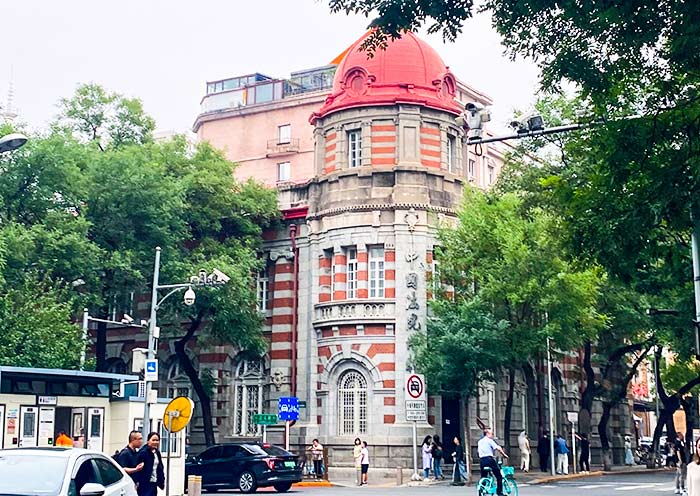
Dongjiaominxiang, once the longest hutong in Beijing, stretches over 1 kilometer and holds a unique place as the city's former diplomatic hub. Throughout the 20th century, this area symbolized the foreign presence in China's capital.
Today, while many of the embassies are gone, the street still has that old-world charm, with a mix of Western and Chinese architecture. It's a great place to learn about the history of Beijing and see how different cultures have influenced the city.
St. Michael's Catholic Church; the former French Post Office; the old Yokohama Specie Bank.
11. Liulichang Cultural Street (琉璃厂文化街) — Antiques & Calligraphy
Metro: Hepingmen (Line 2)
Time: 45 min–1 hr
Best for: Chinese art, calligraphy supplies, cultural shopping
"Glazed Tile Factory Street" has been Beijing's center for traditional art and scholarship since the Qing Dynasty. When the kilns that gave it its name relocated, booksellers, antique dealers, and calligraphers moved in.
Today, the restored Qing-style street is the best place in Beijing to buy calligraphy supplies, Chinese paintings, antique books, and stone seals.
 5 Days
 1 Place
12. Bada Hutong (八大胡同) — Beijing's Storied Entertainment District
Metro: Qianmen (Line 2)
Time: 30–45 min
Best for: Social history, unpolished old Beijing
The "Eight Great Lanes" in the Dashilar area served as Beijing's most famous red-light district during the late Qing and early Republican era — where courtesans, opera performers, intellectuals, and politicians mixed in teahouses, theaters, and exclusive clubs.
The architecture here, some of the most ornate in old Beijing, reflects the wealth that flowed through the district.
Today, Bada Hutong is quiet and largely residential. The old buildings — some preserved, others crumbling — offer an unvarnished look at a layer of history the more polished neighborhoods tend to smooth over.
The ornate courtyard gates on Baishun Hutong and Shitou Hutong, hinting at the district's former lavishness.
Self-Guided Hutong Walking Routes
Route 1: Nanluoguxiang → Shichahai Classic Walk
Duration: 2.5–3 hours
Distance: ~3.5 km
Highlights: Nanluoguxiang side alleys → Mao'er Hutong historic residences → Yandai Xiejie shopfronts → Silver Ingot Bridge views → Houhai Lake atmosphere.
Start at Nanluoguxiang Metro (Lines 6 & 8), Exit B. Walk north along the main lane, turning into the quieter side alleys — especially Mao'er Hutong (east) and Ju'er Hutong (east).
At the northern end, turn left (west) onto Gulou Dong Dajie toward the Drum Tower. Before reaching it, turn right into Yandai Xiejie. Walk the full length, emerging at the Silver Ingot Bridge overlooking the lakes.
Cross the bridge and walk along the western shore of Houhai Lake, past willow trees and lakeside bars. Continue northwest along Xihai for a quieter finish. End at Jishuitan Metro (Line 2) or loop back to the Drum Tower.
Route 2: Dongsi → Guozijian Cultural Walk
Duration: 2–2.5 hours
Distance: ~3 km
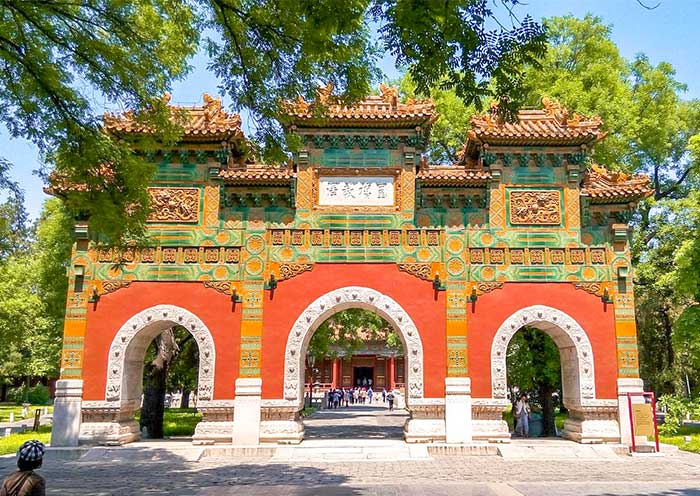
Highlights: Dongsi residential lanes → well-preserved courtyard gates → Guozijian paifang archways → Confucius Temple → Wudaoying cafés.
Start at Dongsi Metro (Lines 5 & 6), Exit C. Walk west into the Dongsi cluster, entering Dongsi Sitiao (Fourth Lane) and walking its full length.
Zigzag north through the parallel lanes — Wutiao (Fifth), Liutiao (Sixth) — exploring courtyards and cross-alleys. Exit northward onto Jiaodaokou Nan Dajie and continue to Guozijian Street.
Walk west under the paifang archways, visiting the Confucius Temple. Continue west to Wudaoying Hutong for a café break. End at Yonghegong Metro (Lines 2 & 5).
Both routes are best started in the morning. Route 1 finishes near Houhai, which comes alive in the evening — consider returning for dinner or a lakeside drink.
Best Ways to Explore Beijing's Hutongs
| Method | Best For | Coverage | Cost |
|---|---|---|---|
| Walking | Intimate details, flexibility, photography | 1 neighborhood per 2–3 hrs | Free |
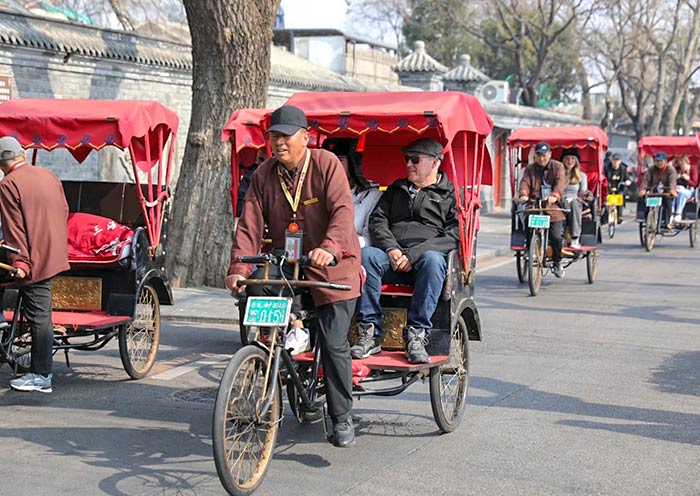
| Rickshaw | Comfort, overview, guided commentary | Shichahai area, 45–60 min loops | ¥150–400 |
| Cycling | Speed + atmosphere balance, multiple areas | 2–3 neighborhoods per half day | ¥1–2/ride (shared bikes) |
| Guided tour | Depth, stories, access to private courtyards | Tailored | Varies |
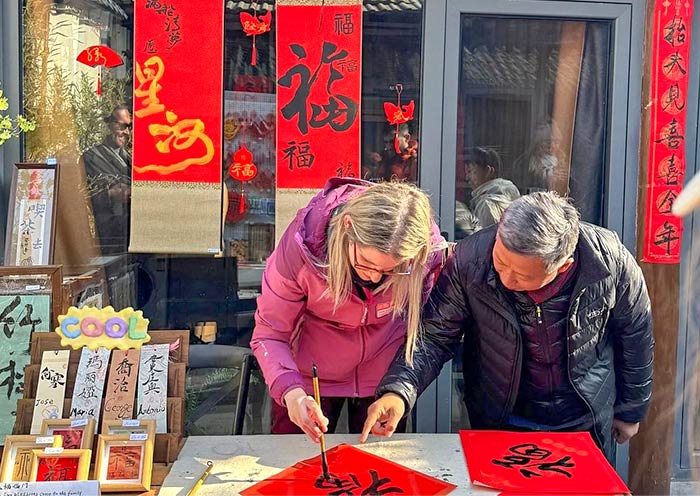
| Family visit | Cultural immersion, seeing inside a siheyuan | Single courtyard + conversation | Usually included in guided tours |
Walking rewards patience. It lets you notice details — a carved door knocker, a cat on a wall, steam rising from a noodle shop — that you'd miss at any other speed.
Rickshaw tours in the Shichahai area are the classic hutong experience. Drivers often double as informal guides and many standard routes include a stop at a local family's courtyard home.
Expect ¥150–200 per person for shared tours, ¥300–400 for private rides. Find them near the Silver Ingot Bridge, outside the Drum Tower, and along Houhai Lake.
Cycling is ideal via Beijing's shared-bike apps (Meituan, Hellobike — pick up and drop off anywhere via smartphone). The Wudaoying, Shichahai, and Dongsi areas are especially enjoyable by bike.
A local guide can decode architectural details (the number of door studs indicates rank; gate orientation reflects feng shui), share resident histories, and arrange access to private courtyards not open to the general public.
How Much Time Do You Need for a Beijing Hutong Visit?
- 1 to 2 hours: enough for one main hutong area such as Nanluoguxiang or Wudaoying
- Half a day: enough for two or three connected hutong areas plus food or a nearby temple
- A full day: ideal if you want to combine hutongs with major nearby attractions such as Lama Temple, the Drum Tower, Shichahai, or Qianmen
If your schedule is limited, a half-day hutong outing is often the sweet spot.
Can You Stay in a Hutong in Beijing?
Yes, and staying in a hutong can be one of the most memorable parts of a trip to Beijing.
Many traditional courtyard homes have been converted into boutique hotels or guesthouses, allowing travelers to experience a more intimate side of the city.
These properties often preserve original architectural details such as carved wooden elements, tiled roofs, and courtyard layouts while still offering modern comforts.
| Property | Location | Character | Price Range |
|---|---|---|---|
| Orchid Hotel | Baochao Hutong (near Nanluoguxiang) | Restored Qing-era courtyard, contemporary design | ¥800–1,500/night |
| Côté Cour Beijing | Yanyue Hutong (Dongsi area) | Quieter residential setting, refined | ¥600–1,200/night |
| Courtyard guesthouses (Airbnb/local platforms) | Various hutong locations | Range from basic to boutique | ¥400–1,000/night |
When choosing, consider the trade-off:
locations near Nanluoguxiang or Shichahai are the most convenient for sightseeing but noisier. Properties in the Dongsi or Dashilar areas are quieter and give a more authentic residential feel.
How to Plan a Beijing Hutong Tour (Itinerary)

Planning a tour of Beijing's hutongs can be a delightful and enriching part of your itinerary, allowing you to experience the city's historic charm amidst its rapid modernization. Here's how you can incorporate a visit to the hutongs into a well-rounded 5-day Beijing trip:
Day 1: Arrival in Beijing
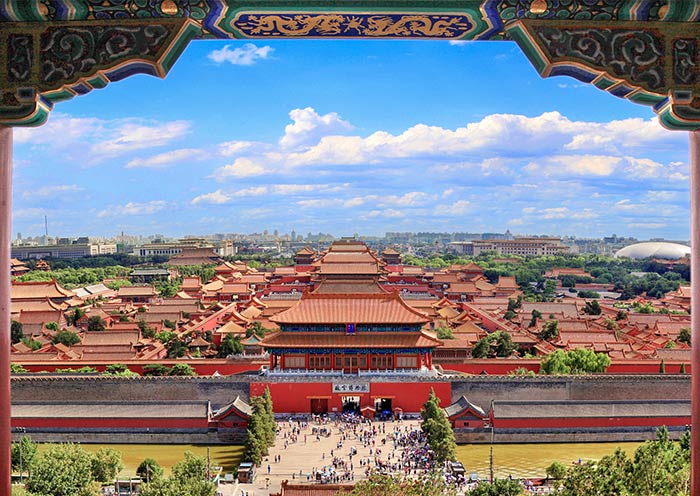
Day 2: Beijing City Tour. Dive into the rich history of Beijing with a visit to Tian'anmen Square and the magnificent Forbidden City. In the afternoon, explore the vast and beautiful Summer Palace, enjoying its peaceful landscapes and grand architecture.
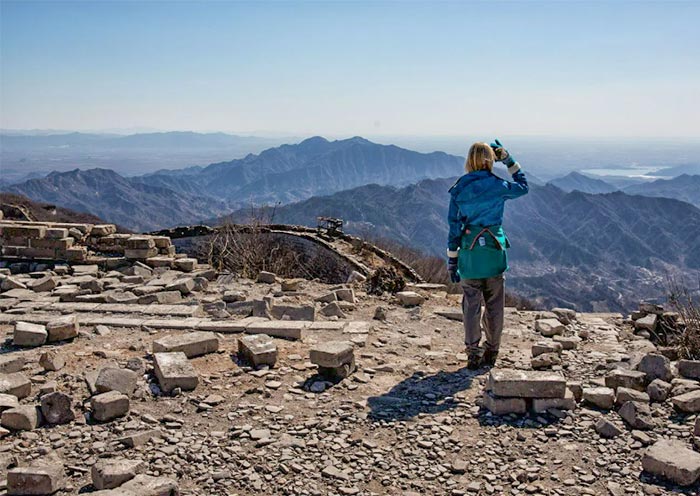
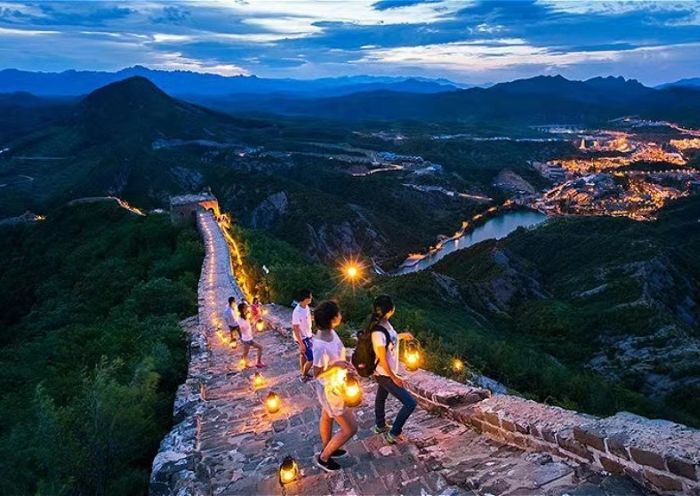
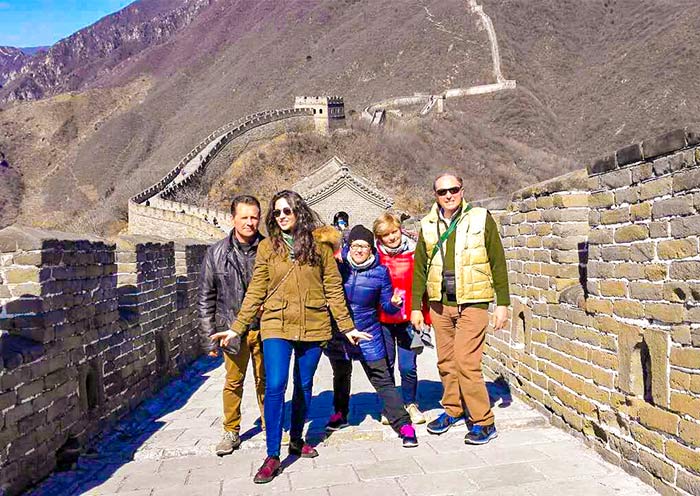
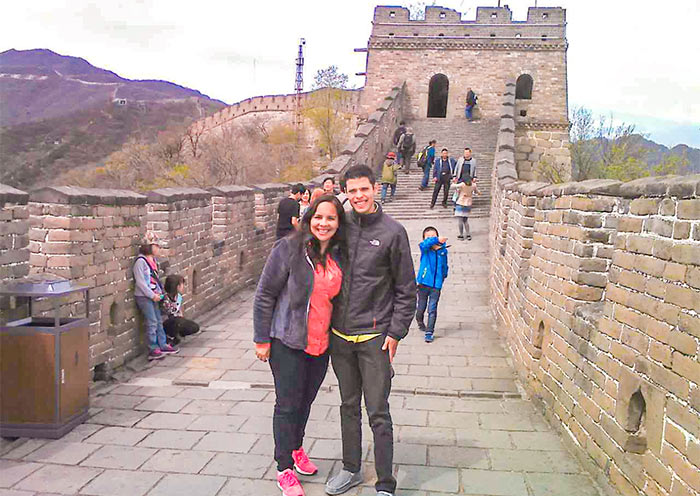
Day 3: Great Wall Adventure. No visit to Beijing is complete without seeing the Great Wall. The Mutianyu section offers a less crowded experience with stunning views. On your way back to the city, stop by the Olympic Park to see the iconic Bird's Nest and Water Cube.
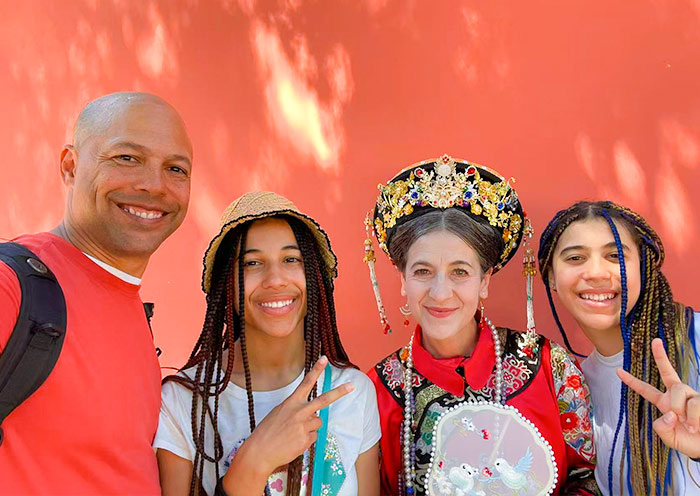
Day 4: Beijing Hutongs Tour. Through the Lama Temple and the Guozijian Street, offering a deep dive into ancient Chinese education. Experience local life firsthand with a hutong family visit, savor traditional Beijing cuisine, and enjoy a rickshaw tour around the scenic Shichahai area.
Day 5: Beijing Departure
Travel to Beijing With Asia Odyssey Travel (AOT)
Experience the best of Beijing with Asia Odyssey Travel (AOT). As local experts, we've been crafting unforgettable journeys through the city for years.
From the Forbidden City's grandeur to the hutongs' vibrant energy, we'll create a personalized itinerary that captures your interests.







 Data in submission...