+852 5394 6901
 Take China Group Tours in 2026/2027 to enjoy 30% discount compared to private tour. Same Experience & Lowest Price!

Hangzhou Tourist Places at A Glance: Top Attractions Map & Quick Reference
Before you dive into the details, here's a simple overview of Hangzhou's must-see spots—grouped by area and travel time from West Lake (the city's heart).
| Area | Top Attractions | Travel Time from West Lake | Best For |
|---|---|---|---|
| West Lake Zone | West Lake, Leifeng Pagoda, Lingyin Temple | 0–40 mins | First-timers, classic views, culture |
| Historic Old Town | Qinghefang Street, Xiaohe Zhijie, Six Harmonies Pagoda | 20–40 mins | Local life, shopping, quiet walks |
| Tea Country | Meijiawu Village, Longjing Village, China National Tea Museum | 30–60 mins | Tea tasting, nature, photography |
| Beyond the Center | Xixi Wetland, Liangzhu Site, Grand Canal | 30–80 mins | Nature lovers, history buffs |
| Modern Hangzhou | Qianjiang New City Light Show, Hema Supermarket | 20–30 mins | Tech fans, night views |
| Day Trips | Wuzhen, Xitang, Nanxun | 60–120 mins | Water towns, weekend getaways |
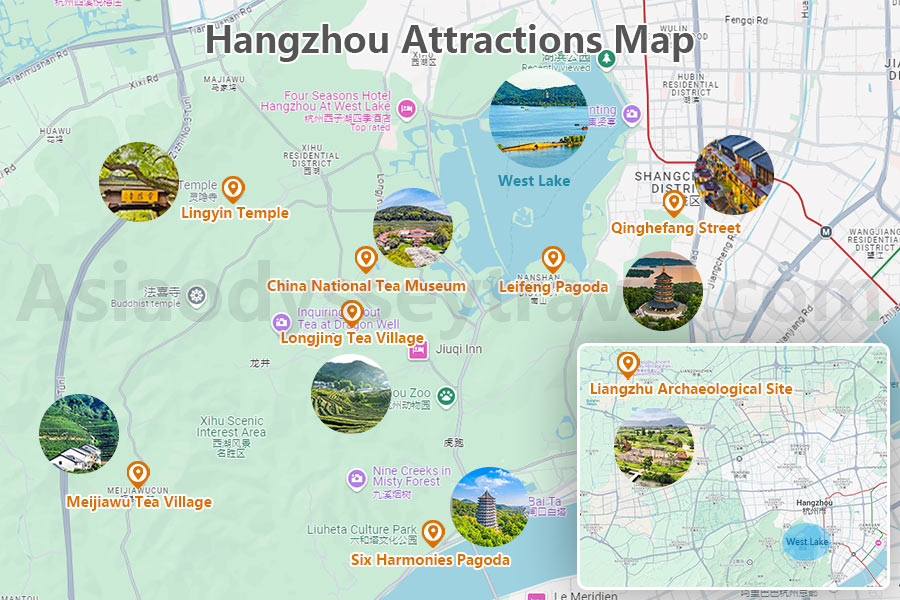
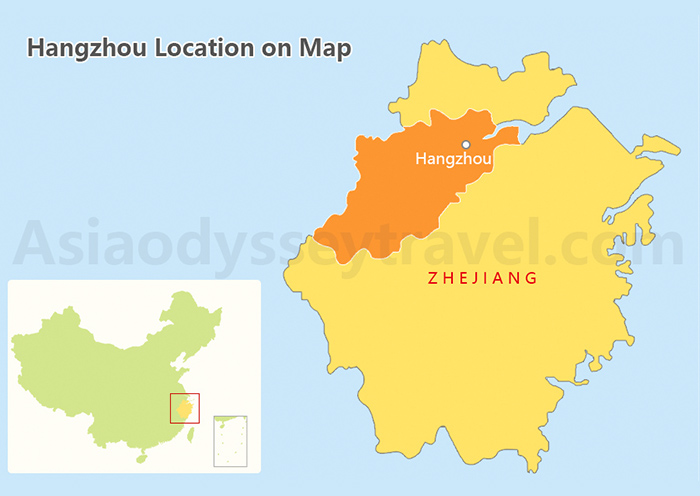
Asia Odyssey Travel has created a handy Hangzhou tourist map just for you! We've pinned all the attractions mentioned in this article, making it incredibly easy to find their locations and plan your perfect itinerary.
Top Hangzhou Attractions in West Lake Area (Start Here!)
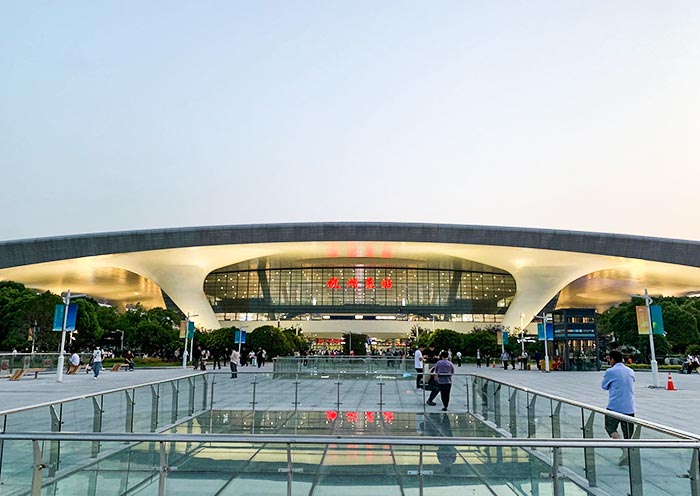
Most first-time visitors arrive at Hangzhou East Railway Station, drop their bags at a hotel, and head straight to West Lake. That's exactly what you should do.
The lake and its surrounding temples form Hangzhou's main attraction, and you could easily spend two days exploring this area alone.
1. West Lake – The Heart of Hangzhou (And Why It's Not Just a Pretty Picture)
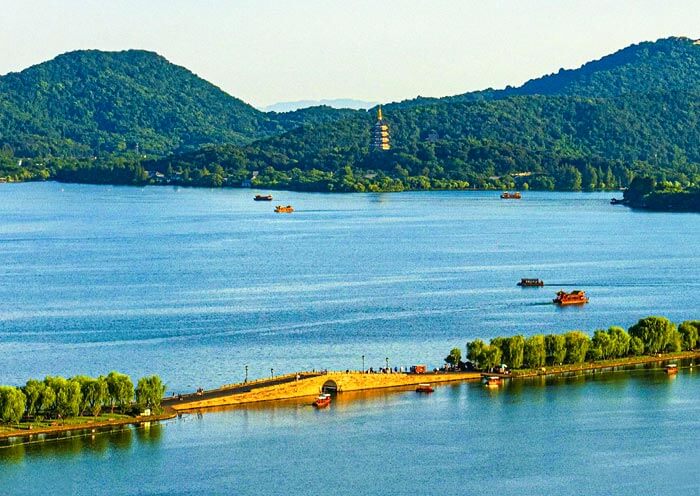
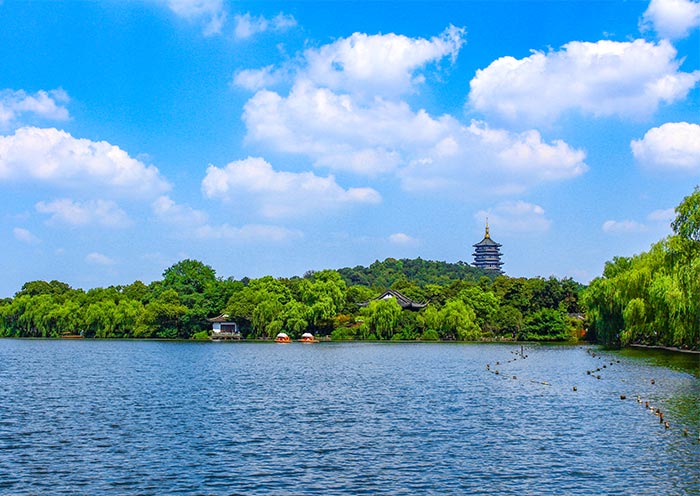
West Lake is the China's most famous scenic spots. Chinese poets have written about this lake for over a thousand years. Every educated Chinese person knows at least one poem about West Lake by heart.
The lake covers about 6.5 square kilometers, with a walking path circling the entire perimeter. It's about 15 kilometers and will take 3-4 hours without stops by foot.
You don't need to pay to enjoy West Lake's public areas, walking paths, and causeways are 100% free to visit 24/7. Spend at least half a day here.
The famous "Ten Scenes of West Lake" are scattered around the shoreline. Honestly, most look similar to untrained eyes—pretty water, pagodas, trees. The exceptions worth seeking out:
- Three Pools Mirroring the Moon: The lake's landmark. Three small stone pagodas in the lake that appear on the back of China's 1-yuan note. Only accessible by boat (boat ticket includes island entry, approx. 70 RMB / $10 USD per person).
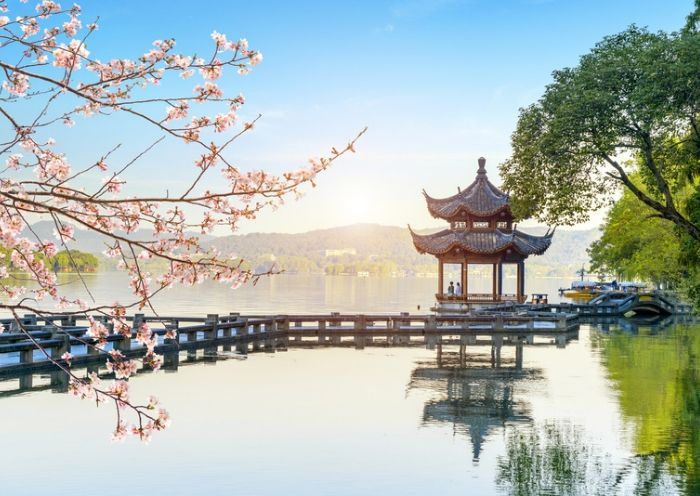
- Su Causeway: The 2.8km causeway is lined with willow and peach trees, which bloom with pink and white flowers in spring (March to April), making it most famous of the Ten Scenes of West Lake, with six bridges.
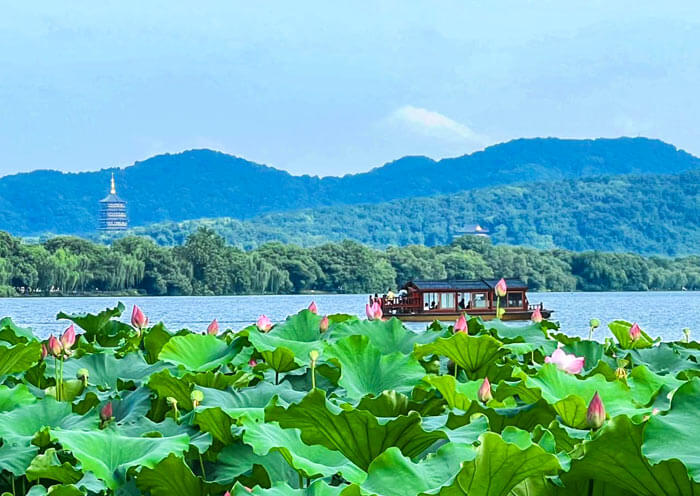
- Quyuan Lotus Pool: Stunning in summer, when the lotus flowers are in full bloom.
- Broken Bridge: The iconic spot famous for its winter snow scene.
Walking, cycling, and taking a boat are all fantastic ways to explore West Lake. If you're traveling with family, the round-the-lake sightseeing bus is a great choice at 40 RMB (about $5.50 USD). If you want to experience a mix of everything in one trip, here is a great route to try:
- First, exit the subway at Longxiangqiao Station, head over to the First Park Pier (Yigongyuan), and take a boat to Three Pools Mirroring the Moon.
- Afterward, rent a bicycle and ride along the Su Causeway toward the Yue Fei Temple.
- Finally, enjoy a leisurely stroll down the Bai Causeway and make your way onto the famous Broken Bridge.
2. Lingyin Temple & Feilai Peak – Find Peace at a Thousand-Year-Old Buddhist Temple
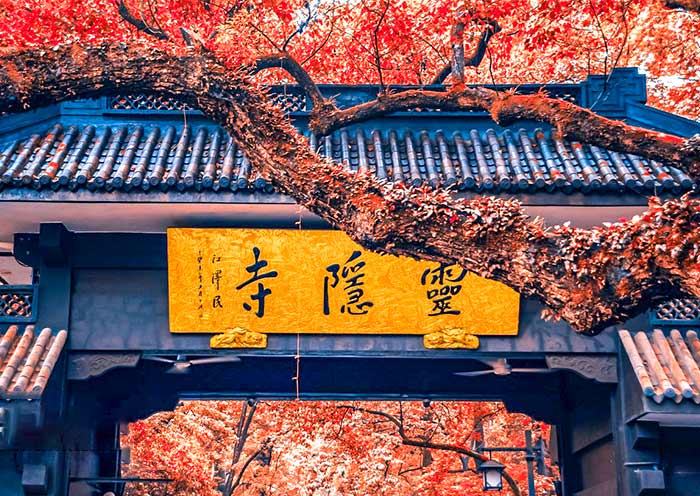
Tucked in the forested hills just 4km from West Lake, Lingyin Temple is one of China's largest and wealthiest Buddhist monasteries.
For over 1,600 years, it has been a vital center for Zen Buddhism. It's also a celebrity hotspot—photos of American pop star Katy Perry exploring the temple even went viral here in 2025!
Your visit includes two main sites:
- Part 1: Feilai Peak (Flying Peak) Before reaching the temple, you'll walk past a cliff face covered in 470 Buddhist stone carvings dating back to the 10th century. Taking about 30–45 minutes to explore, the highlight is the Yuan Dynasty Laughing Buddha, whose belly has been rubbed smooth for good luck.
- Part 2: Lingyin Temple Complex Continuing up the mountainside, you'll enter the main temple grounds. The centerpiece is the magnificent 20-meter-tall gilded Sakyamuni Buddha, intricately carved from camphor wood—one of the largest in China.
Hikers' Bonus: Behind the temple, a 30-to-40-minute trail leads up North Peak (北高峰) for panoramic views of West Lake and the city.
Great news for visitors! As of December 1, 2025, admission is completely free for Lingyin Temple, Feilai Peak, Yongfu Temple, and Taoguang Temple.
However, you still need to make a free reservation via their WeChat Mini Program using your passport or ID card.
- Reservations open 7 days in advance.
- Same-day bookings are not permitted, so be sure to plan ahead.
3. Leifeng Pagoda – Sunset Views & the Legend of the White Snake
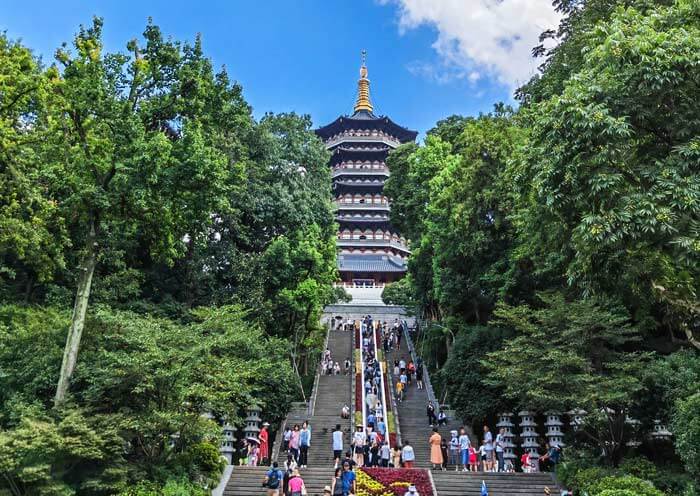
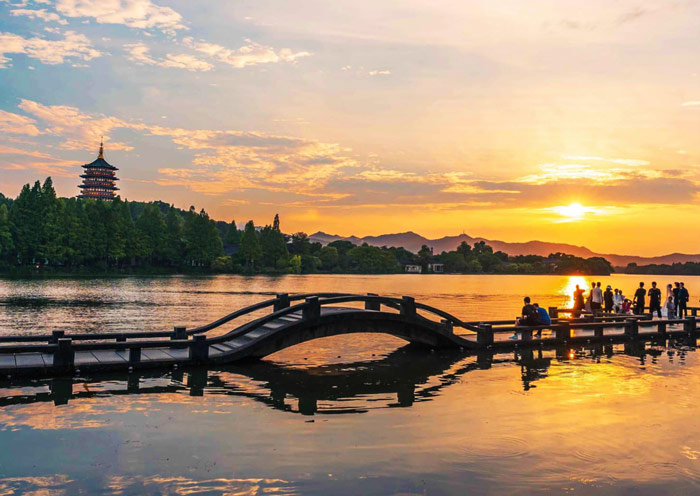
Leifeng Pagoda (雷峰塔) sits on Sunset Hill overlooking West Lake's southern shore. The original structure collapsed in 1924, and what you see today is a 2002 reconstruction with modern amenities (elevators, mood lighting) built around the ancient ruins.
The Love Story Everyone Knows: The pagoda is famous for the legend of Bai Suzhen, a white snake spirit imprisoned beneath it by a monk for loving a human. Her son eventually freed her. A happy-ending Chinese Romeo and Juliet.
What to See:
- First, the underground floor. Glass floors let you walk over the original pagoda ruins and foundation (the highlight for history buffs).
- Second, the Observation Decks. The 5th floor offers 360° views of West Lake and surrounding hills. The pagoda's southern position gives you the perfect angle to see the entire lake, the causeways, and the city skyline behind it.
- Third, the sunset timing. The pagoda faces west, so sunset light hits the building and lake beautifully. Come about an hour before sunset.
If you've already caught a stunning West Lake sunset over by the Broken Bridge, I'd actually suggest skipping this spot.
However, if you are specifically looking for breathtaking panoramic views of the lake at golden hour, paying the 40 RMB entrance fee for Leifeng Pagoda is absolutely worth it.
4. China National Tea Museum – Your Free Introduction to Chinese Tea
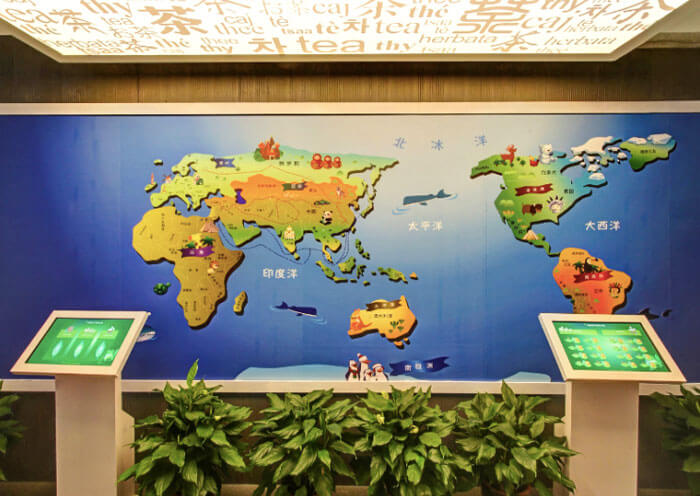
Before you visit tea villages where farmers will try to sell you expensive tea leaves, spend an hour at this museum learning what you're actually looking at. It's completely free and rarely crowded, located in the hills west of West Lake.
The museum covers Chinese tea's 5,000-year history through well-organized exhibits. You'll learn about the six categories of Chinese tea (green, white, yellow, oolong, black, and dark), how to identify quality leaves, and the proper way to brew different varieties.
The museum grounds include a working tea plantation and a small café where you can practice brewing techniques with staff guidance.
When to skip it: If you're already familiar with Chinese tea culture or extremely short on time. Head straight to the villages in that case.
5. Longjing Tea Villages – Which One to Choose? (Meijiawu vs. Longjing Village)

Three main tea villages sit in the mountains above West Lake. They all grow the same famous tea.
What to expect during a tea village visit (The process is fairly standard across all villages):
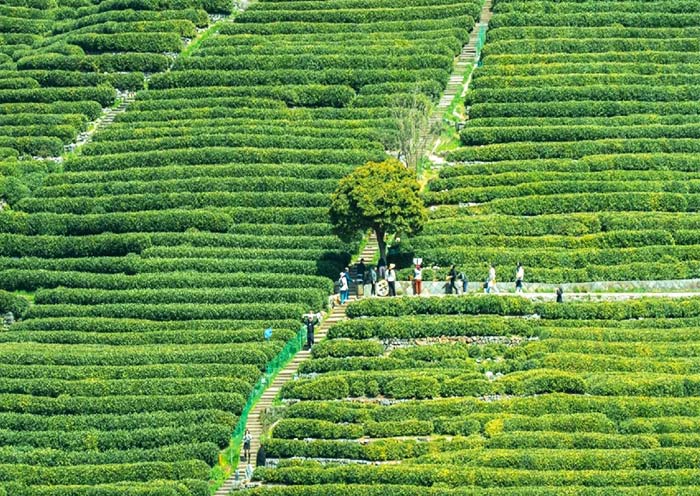
- Tea plantation walk (10-15 min): Walk through the terraced hillside plantations. The farmer explains what makes Longjing tea special—the specific cultivar, the mineral-rich soil, the microclimate around West Lake.
- Tea processing demonstration (10 min): Watch the farmer roast fresh tea leaves in a large wok heated over charcoal. This is only available during March-April tea picking season.
- Tea tasting (30-45 min): Sit down for a proper tea session. The farmer brews multiple rounds of tea, explaining how to appreciate the color, aroma, and taste. This is when the sales pitch begins.
- Sales discussion (15-30 min): They'll show you different tea grades with different prices. You're not obligated to buy anything. Politely declining is perfectly acceptable.
| Feature | Meijiawu | Longjing Village |
|---|---|---|
| Tourist crowds | Medium | High on weekends |
| Tea-picking experience (Mar–Apr only) | Very common. Many family-run tea farms offer tea-picking experiences (50–100 RMB/person). | Yes, mostly at tea Plantation (approx. 80–150 RMB/person). |
| Tea tasting price | ¥50-80 | ¥60-100 |
| Location | 13 km from West Lake | Just 3 km from West Lake |
| Best for | First-time visitors | Photography |
Meijiawu is ideal for most travelers. It strikes the best balance between accessibility and an authentic experience. Vendors speak enough English to explain the tea-making process. The village has proper facilities, including bathrooms, parking, and restaurants. It is touristy, but not overwhelmingly so.
Historic Streets & Ancient Pagodas (Step Back in Time)
For over a millennium, Hangzhou has been a city of poets, merchants, monks, and emperors. Where can you still catch a glimpse of its ancient soul?
From well-preserved Qing Dynasty storefronts to magnificent pagodas dating back to the 10th century, a leisurely stroll through these historic sites will let you truly feel the passage of time.
6. Qinghefang Ancient Street – Medicine Shops, Street Food & Qing Architecture
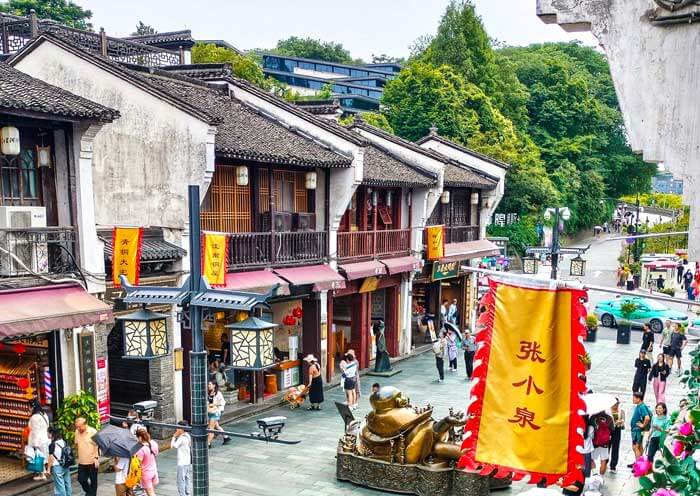
This is Hangzhou's main tourist street, and it doesn't pretend otherwise. This pedestrian street lined with Qing Dynasty architecture, herbal medicine shops, and snack vendors.
It gets touristy, but it's still where locals come to buy mooncakes during Mid-Autumn Festival and New Year decorations in January.
The walking route: Start at Wushan Square and head east down Hefang Street. The street runs about 460 meters to the Drum Tower at the far end. You can stop at some attractions along the way.
- Hu Qing Yu Tang Chinese Medicine Museum (¥10 entry): This 145-year-old pharmacy still operates as a working traditional medicine shop.
- Hu Xueyan's Former Residence (¥20 entry, two blocks south): This mansion belonged to a 19th-century business tycoon and displays classical Chinese architecture at its finest.
Almost everything for sale is also available on Taobao for 30–50% less. However, if you want silk scarves, chopsticks, or tea sets as souvenirs, this is a convenient one-stop shop. Bargain aggressively.
7. Xiaohe Straight Street – The Canal-Side Street Locals Actually Visit
Getting there: Subway Line 1 or 5 to Dayun Canal station, then 10-minute walk. Or combine with a Grand Canal boat trip (see below).
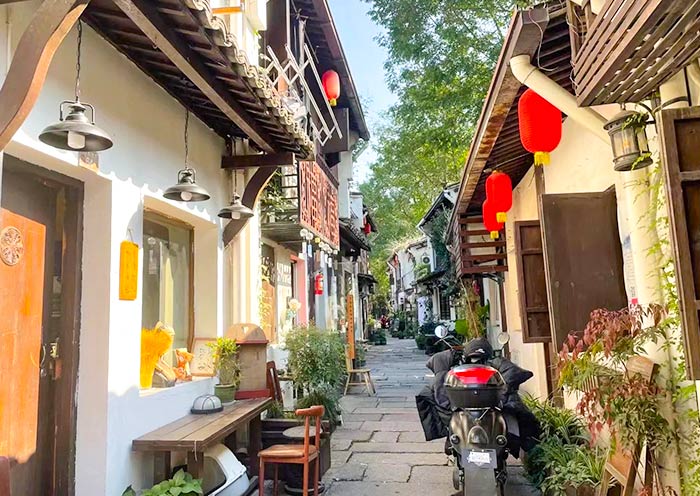
While tourists pack Qinghefang, Xiaohe Straight Street remains mostly local. This 1-kilometer pedestrian street runs along a small canal in northern Hangzhou, lined with Qing Dynasty buildings that were actual residences until recent years.
Old residents still live here, sitting outside their doors playing cards and chatting with neighbors. Small workshops make traditional crafts—bamboo weaving, paper umbrellas, seal carving.
When to Visit?
The street is especially atmospheric in early morning (7-9am) when elderly residents practice tai chi by the canal and vendors sell breakfast from small carts. Or come at dusk when red lanterns light up the waterway.
Getting there:
Subway Line 1 or 5 to Dayun Canal station, then 10-minute walk. Or combine with a Grand Canal boat trip (see below).
8. Six Harmonies Pagoda – River Views Without the Crowds
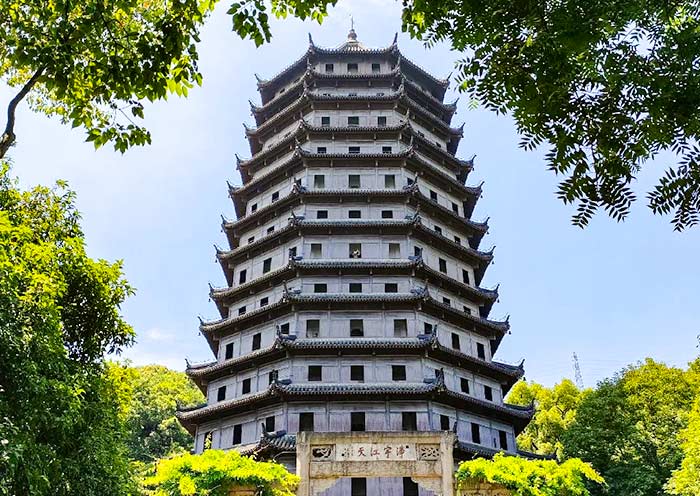
This octagonal pagoda sits on a hill overlooking the Qiantang River, where the river widens before flowing into Hangzhou Bay. It's significantly less famous than Leifeng Pagoda, which means you might have the observation decks nearly to yourself.
The pagoda dates to 970 AD(Song Dynasty), built to "calm the tides" of the Qiantang River (which didn't work—the river still produces one of the world's largest tidal bores).
Best for: Photographers wanting river/bridge shots, people who enjoy quiet temples, or anyone tired of West Lake crowds. Skip it if you're short on time or have already visited Leifeng Pagoda.
- Entry: ¥30 (~$3)
- Can combine with: Hangzhou Zoo or Qiantang River Tide viewing (September is peak tidal bore season)
Extra Half-Day Hangzhou Attractions: 2 UNESCO Sites & Wetland
These three attractions sit farther from the city center and appeal to specific interests. If you have extra time beyond the standard West Lake/tea village circuit, these offer worthwhile diversions.
9. Liangzhu Archaeological Site – 5,000-Year-Old Civilization (UNESCO Site)
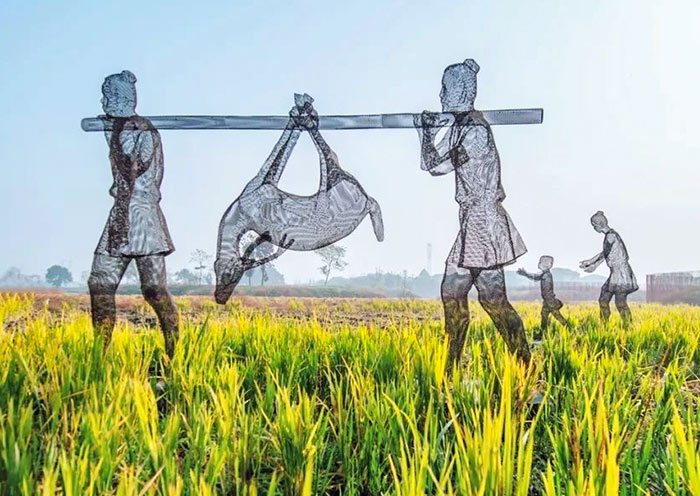
Did you know Chinese civilization is over 5,000 years old? The Liangzhu Site proves it. This UNESCO World Heritage Site reveals jade artifacts, ancient dams, and city ruins from 3300 BC.
What you'll see:
The site includes reconstructed city walls, ancient rice paddies, and a modern museum displaying jade artifacts, pottery, and tools excavated from the area.
The museum's architecture is impressive—a minimalist concrete structure designed by David Chipperfield that won architectural awards.
If you find museums boring or don't care about Neolithic pottery, skip this.
Take Metro Line 2 to Liangzhu Station (approximately 45 minutes from the city center).
Entrance: ¥60 (~$12).
10. Grand Canal – The World's Oldest Waterway (And Why It's Still Alive)
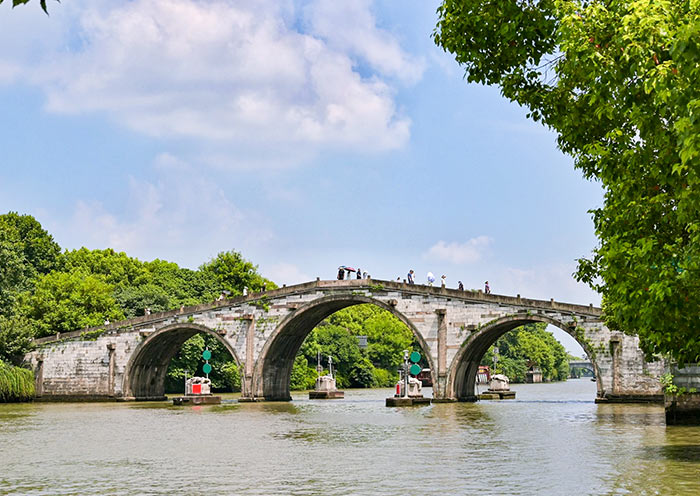
The Grand Canal (京杭大运河) is the world's longest man-made waterway, stretching 1,794 km from Beijing to Hangzhou. It's built over 1,400 years ago and is the world's longest and oldest artificial waterway, making it a UNESCO World Heritage Site.
While it's no longer the economic lifeline it was during the Tang Dynasty, the Hangzhou section still sees cargo barges and tour boats gliding past ancient bridges and converted warehouses.
Gongchen Bridge (拱宸桥), built in 1631, is the canal's most iconic landmark—a triple-arched stone bridge spanning 92 meters. The surrounding Gongchen Bridge Historic District has been gentrified into galleries, cafés, and museums (including the China Knife & Scissor Museum—yes, really).
How to How to Experience It?
Option 1: Scenic Cruise (¥30/$4.5, 1 hour)—Boats depart from Wulin Gate Wharf and pass old shipyards, traditional courtyards, and the Fushui Bridge (still used by cargo ships).
Option 2: Walk the canalside paths (free): The best walking section runs from Gongchen Bridge to Wulin Gate (about 3 kilometers). You'll pass the Canal Museum (free), ancient grain warehouses, and local neighborhoods where life revolves around the water.
Skip this if you're short on time — it's interesting for history buffs, but West Lake and the tea villages should take priority.
11. Xixi National Wetland Park – A Wetland That Feels Like a Secret Forest
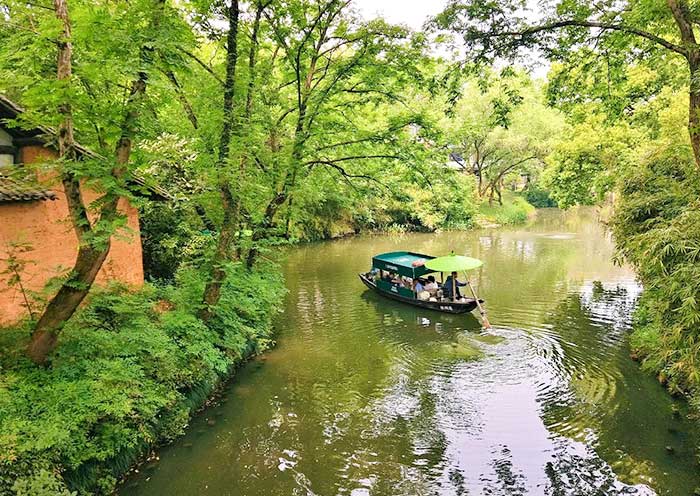
If you love nature walks and want to escape urban Hangzhou completely, this park delivers. This 11-square-kilometer wetland park in western Hangzhou feels nothing like the city just outside its gates.
Inside, you'll find a maze of waterways, traditional water villages, ancient trees, and surprising wildlife for an urban park—egrets, kingfishers, sometimes even wild ducks nesting in the reeds.
Three main sections exist within the park:
- Eastern Area: Most developed, with museums and performance areas
- Central Area: Best for nature observation, fewer structures
- Western Area: Most remote and peaceful, but requires more time to reach
How to Visit?
The park is too large to walk entirely. Rent an electric boat (¥100/~$14.5) for 1 hours) and navigate the waterways yourself, stopping at small islands with pavilions and tea houses.
Unique Night Experiences in Hangzhou
Hangzhou doesn't shut down after sunset. The city offers several distinctive evening activities beyond the standard dinner-and-drinks routine.
12. Impression West Lake Show: A Nighttime Spectacle on the Water
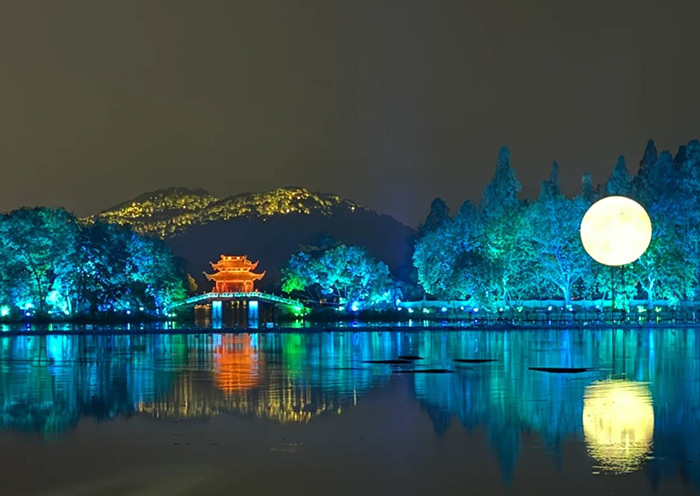
If you've ever wondered what a Chinese blockbuster director would do with an unlimited budget and a lake as his stage, Impression West Lake (印象西湖) is your answer.
This 70-minute outdoor performance features 300+ actors appearing to walk on water (they're on submerged platforms), synchronized fountains, and a storyline pulled from Hangzhou's most famous legends.
What to Expect:
The show is divided into five acts representing different aspects of West Lake's history—from ancient love stories to the city's modern renaissance. There's minimal dialogue (mostly music and dance), so language isn't a barrier.
The backdrop is the actual West Lake and surrounding mountains, with lighting effects transforming the scenery every few minutes.
- Showtimes: 7:30pm and 8:45pm (varies by season).
- Tickets: VIP Zone A2–4 from ¥299–960 ($43–139), Normal Zone A–C ¥259–340 ($37–50).
- Duration: 70 minutes + 30 minutes for entering and exiting.
- Weather: Canceled in heavy rain (full refund), but light drizzle will not stop the show — bring a poncho.
- Location: Yue Lake Scenic Area, near Yue Fei Temple.
13. Song Dynasty Theme Park – Time Travel to 12th Century Hangzhou
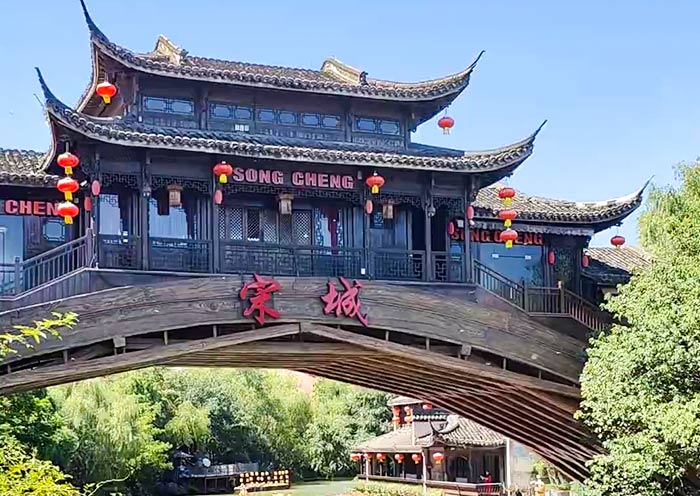
This theme park recreates the entertainment district of Hangzhou during the Southern Song Dynasty (1127-1279 AD), when Hangzhou was China's capital. Think less "theme park" and more "living history museum with performances."
What happens here:
The park comes alive at night with street performances, traditional music, acrobats, and period-costume actors recreating Song Dynasty entertainment. Jugglers, musicians, storytellers, and performers demonstrate ancient crafts and art forms.
The main show: "Song Dynasty Banquet" combines dinner with a staged performance featuring 300+ actors, musicians, and dancers. You eat while watching scenes from Song court life, battles, and celebrations unfold around you. The food is decent but secondary to the spectacle.
Best for: Families with kids, Chinese history enthusiasts, or anyone who enjoyed Beijing's hutong culture and wants to see Hangzhou's historical equivalent.
- Getting there: Subway Line 4 to Shuichengqiao Station, then a 10-minute walk.
- Entry Fee: ¥320–350 ($45–52).
Best Day Trips from Hangzhou: Wuzhen vs. Xitang vs. Nanxun Compared
The region around Hangzhou is dotted with ancient water towns—villages built along canals, with white-walled houses, stone bridges, and narrow waterways instead of roads.
Three towns are easily reachable from Hangzhou as day trips, each with distinct characteristics.
| Town | Vibe | Travel Time | Best For |
|---|---|---|---|
| Wuzhen | Polished, well-restored | 1 hour by bus | First-timers, photography, comfort |
| Xitang | Lively, lantern-lit alleys | 1.5 hours | Night walks, local food, charm |
| Nanxun | Quiet, less touristy | 1 hour | Peace, authenticity, gardens |
14. Wuzhen – The Most Famous (and Most Polished)
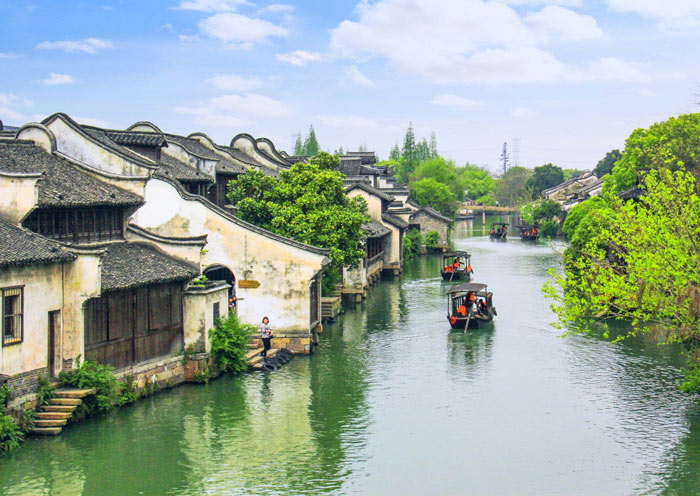
Wuzhen is China's most famous water town, meticulously restored and maintained to picture-perfect standards. Some call it too touristy and artificial.
It's undeniably beautiful. The town looks exactly like traditional Chinese paintings of Jiangnan water towns—whitewashed walls with black tile roofs, stone bridges arching over canals, wooden boats poling through narrow waterways, willow trees trailing into the water.
The town splits into two sections:
- East Gate (Dongzha): The older, smaller section with authentic Ming and Qing architecture. More residential, fewer shops.
- West Gate (Xizha): Larger, newer section opened in 2007. More commercial with boutique hotels, restaurants, and shops. More photogenic.
15. Xitang – The Most Atmospheric (Especially After Dark)
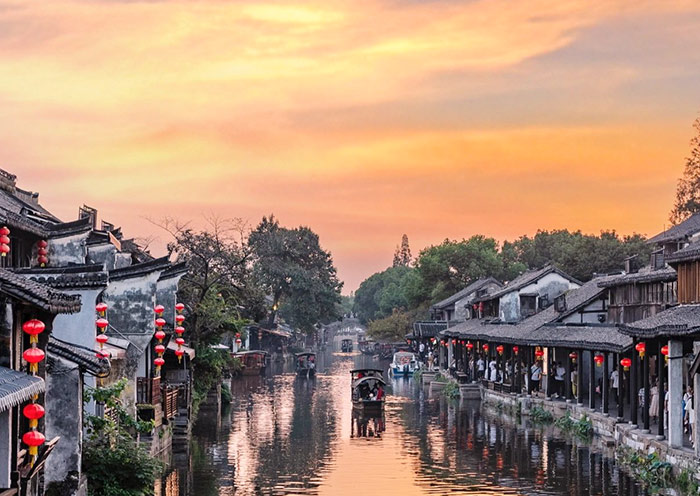
Xitang is less polished than Wuzhen but more atmospheric. This is the water town where Mission Impossible 3 filmed its Chinese village scenes.
Long covered walkways run along the canals, with wooden roofs supported by ancient pillars. These corridors stretch over 1,000 meters total, letting you walk the town entirely under cover. On rainy days, this makes Xitang the most pleasant water town to visit.
The night scene: After dark, red lanterns illuminate the canals. Bars along the waterfront blast music and attract young Chinese crowds.
Best for: Photographers (especially at dawn or dusk), people who want a balance between authentic and accessible, anyone put off by Wuzhen's theme-park perfection.
16. Nanxun – The Most Underrated (Fewest Tourists)
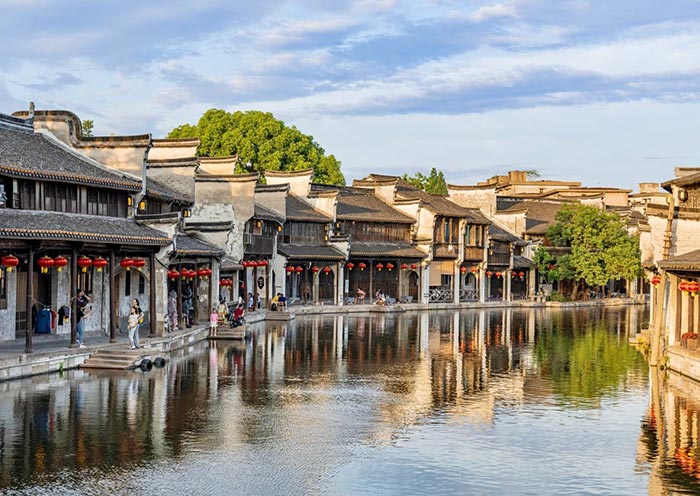
Nanxun receives a fraction of Wuzhen's visitors despite being equally beautiful and far more authentic. This is where you go when you want a genuine water town experience without fighting crowds.
It's less cute and picture-perfect than the other two. The town is bigger, less concentrated, with normal modern life happening alongside the historic areas.
The town also has a unique feature: wealthy silk merchants built elaborate mansions here in the 19th century, blending Chinese and European architecture.
- Limited time or first visit: Wuzhen (easiest access, guaranteed beautiful photos)
- Want atmosphere and nightlife: Xitang (most lively evening scene)
- Prefer authenticity: Nanxun (fewest tourists, most real)
- Have 2+ days: Visit two towns for comparison
Bonus: The Tech Side of Hangzhou
Yes, Hangzhou is ancient—but it's also China's tech capital. Home to Alibaba, it's clean, smart, and surprisingly futuristic.
17. Catch the "Future City" Light Show at Qianjiang New City
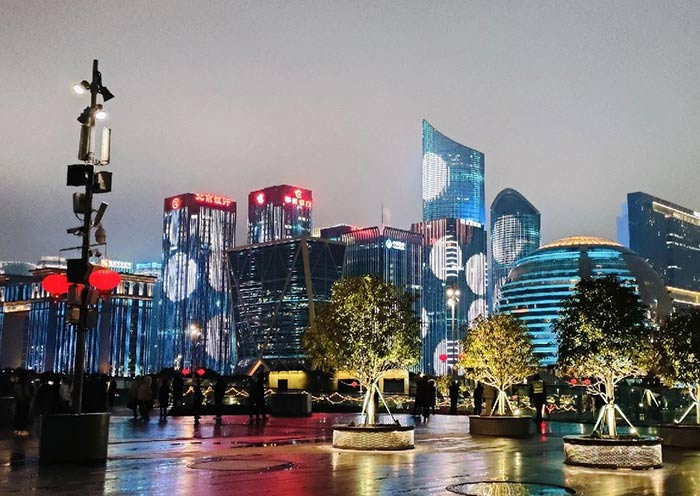
Every evening, the skyscrapers along Qianjiang New City's riverside put on a synchronized light show. Forty-plus buildings become giant LED screens displaying coordinated patterns, colors, and animations.
15-20 minutes of lights synchronized to music, with different themes rotating weekly. Sometimes it's abstract patterns. Other times it's imagery celebrating Chinese festivals or holidays. The buildings essentially become pixels in a massive citywide screen.
- Where to watch: Citizen Center Square or the pedestrian walkway along the Qiantang River.
- Show times: Usually 7:30pm and 8:30pm.
- Getting there: Subway Line 2 or 4 to Citizen Center Station.
18. Alibaba HQ Campus & Hema Supermarket (If You're Curious)
While you can't tour Alibaba's headquarters, you can visit their Hema Fresh supermarket—a high-tech grocery store where you scan items with your phone and robots deliver your order. It's fun, efficient, and a glimpse into China's retail future.
Find Hema in most major malls (e.g., MixC Mall).
How Many Days in Hangzhou? Perfect Itineraries for 1–3 Days
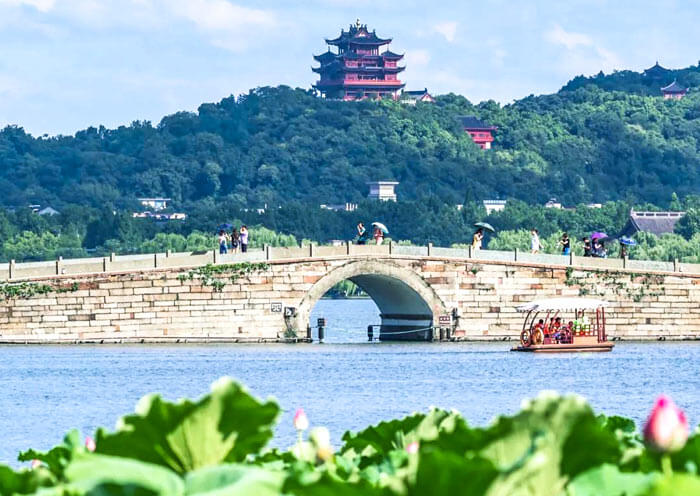
Many travelers visit Hangzhou as a quick add-on from Shanghai via a 45-to-90-minute high-speed train ride.
1 Day from Shanghai: West Lake walking loop + Lingyin Temple + Qinghefang Street (rushed but doable)
2 Days: Day 1 = West Lake + Tea Village + Leifeng Pagoda. Day 2 = Wuzhen Water Town day trip
3 Days: Add Liangzhu Archaeological Site or Grand Canal, with more time to linger at each spot
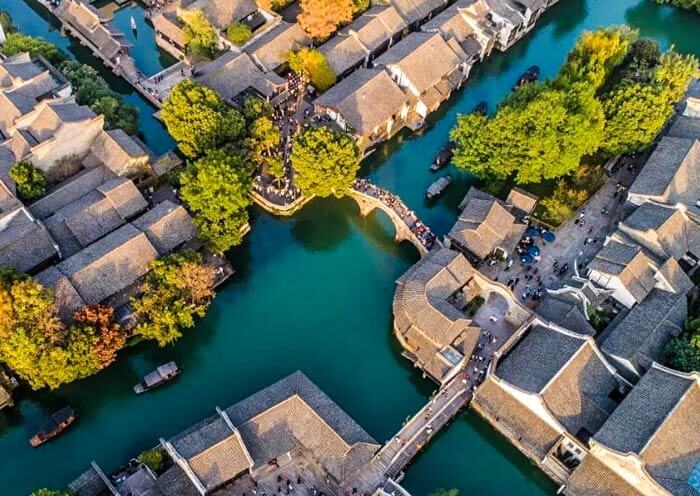
2 Days Hangzhou Tour - A Glimpse of Jiangnan with Wuzhen Water Town
Hangzhou - Wuzhen
 2 Days
 2 Places
Practical Tips: Getting There, Transport & Where to Stay
How to Get to Hangzhou? By High Speed Train or Flight?
| From City | High Speed Train | Flight |
|---|---|---|
| Shanghai | 45-90 min/from $5 | / |
| Beijing | 5-14 h/ from $48 | 2 h/ from $52 |
| Hong Kong | 7-10h/from $96 | 2-2.5h/ from $93 |
Flying remains the most convenient way to reach Hangzhou from China's major gateway cities. However, for nearby cities like Shanghai, the high-speed rail is undoubtedly your best bet.
A great rule of thumb: if the train ride takes longer than four hours, definitely opt for a flight. For budget-conscious travelers, traditional overnight trains still offer excellent value for money.
How to Get Around Hangzhou?
From Hangzhou Xiaoshan International Airport (HGH). Take Metro Line 1 or a taxi (30 mins, ~$25) to downtown.
Subway: The Hangzhou Metro has 12 lines that cover all major attractions, including West Lake, Lingyin Temple, Liangzhu Ruins, and the airport. All ticket machines and station signs have English.
Buses: The city's bus system covers the entire city, and most buses have English announcements and stop signs.
Ride-Hailing: Didi Chuxing (China's version of Uber) has an English app that accepts international credit cards. It is cheap, safe, and the easiest way to get around if you don't speak Chinese.
Bikes: Public shared bikes are available everywhere in Hangzhou, and they are the best way to explore West Lake.
Where to Stay in Hangzhou for First-Time Visitors
| Area | Why Stay Here? | Close To | Best For | Avg. Price/Night (2026) |
|---|---|---|---|---|
| West Lake (Hubin / Shangcheng) | Heart of the city. Walk to lake, shops & food. | West Lake, | First-timers, couples, families | $80–$250 |
| Wulin Square / Downtown | Modern, great metro access, lots of restaurants | Metro lines 1 & 2, Grand Canal, night markets | Budget travelers, solo travelers | $50–$150 |
| Meijiawu / Longjing Village | Peaceful tea fields, fresh air, authentic vibe | Tea plantations, China National Tea Museum | Nature lovers, tea enthusiasts, slow travelers | $70–$200 |
| Qianjiang New City | Futuristic skyline, light shows, quiet at night | Alibaba HQ, Qiantang River, modern malls | Tech travelers, luxury seekers | $100–$300 |
| Near Hangzhou East Railway Station | Super easy for train arrivals/departures | High-speed train station | transit travelers, budget groups | $40–$100 |
Book early in spring (Mar–May) and autumn (Sep–Oct) — Hangzhou gets busy!
Visa Free to Visit Hangzhou
One of the biggest reasons Hangzhou is such a great destination for foreign visitors is its easy visa access:
15-Day Visa-Free Policy: Citizens of 48 countries (including the US, UK, Canada, Australia, New Zealand, most EU countries, Japan, South Korea, Singapore, and many more) can visit Hangzhou and all of mainland China visa-free for up to 15 days.
240-Hour Transit Visa-Free Policy: If you are transiting through China to another country, you can stay in Hangzhou and the surrounding Zhejiang Province for up to 10 days (240 hours) without a visa.
Best Time to Visit Hangzhou
The best time to visit Hangzhou is spring (March to May) and autumn (September to November).
Spring brings mild weather, blooming peach and cherry blossoms, and the famous Longjing tea harvest.
Autumn has cool, dry weather, beautiful fall foliage, and fewer crowds than spring.
Discover More of the Yangtze River Delta with Asia Odyssey Travel
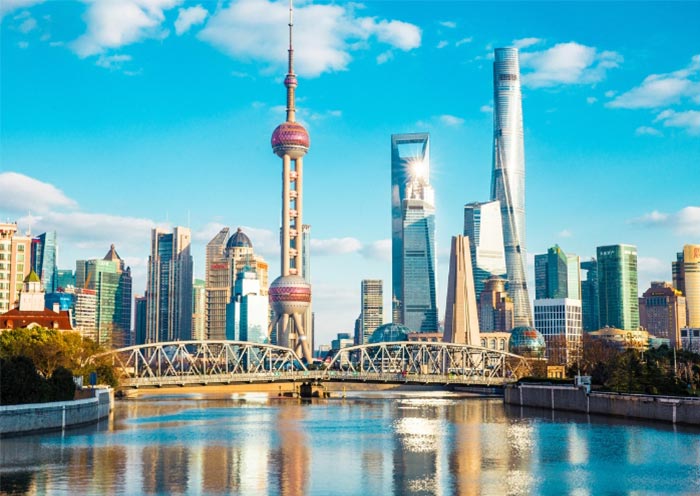
Beyond Hangzhou's serene beauty lies a region of dynamic contrasts. From Shanghai's modern skyline to Suzhou's classical gardens, the Yangtze River Delta offers endless possibilities for exploration.
Let Asia Odyssey Travel design a personalized journey that connects these remarkable destinations. Contact us today to start planning your adventure.







 Data in submission...