+852 5394 6901
 Take China Group Tours in 2026/2027 to enjoy 30% discount compared to private tour. Same Experience & Lowest Price!

Jeonju Location Map: Where Is Jeonju in South Korea?
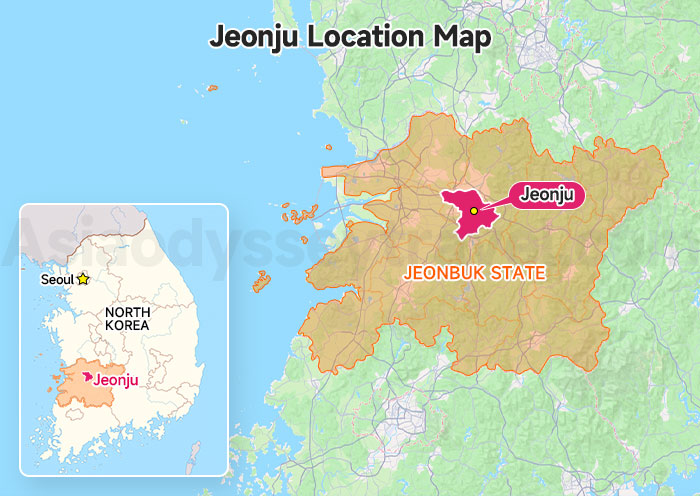
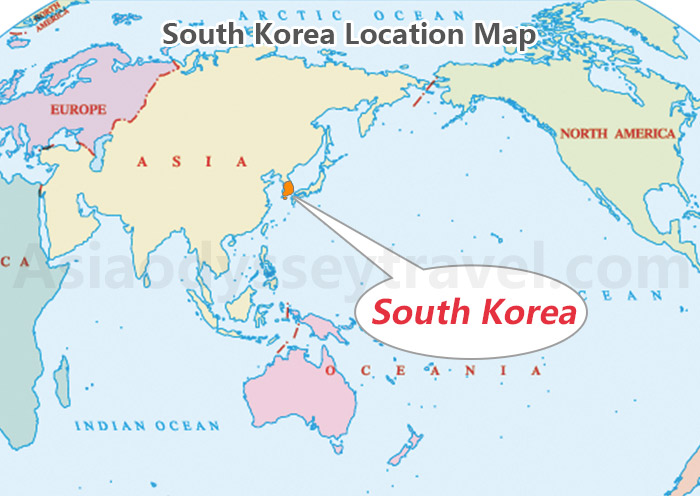
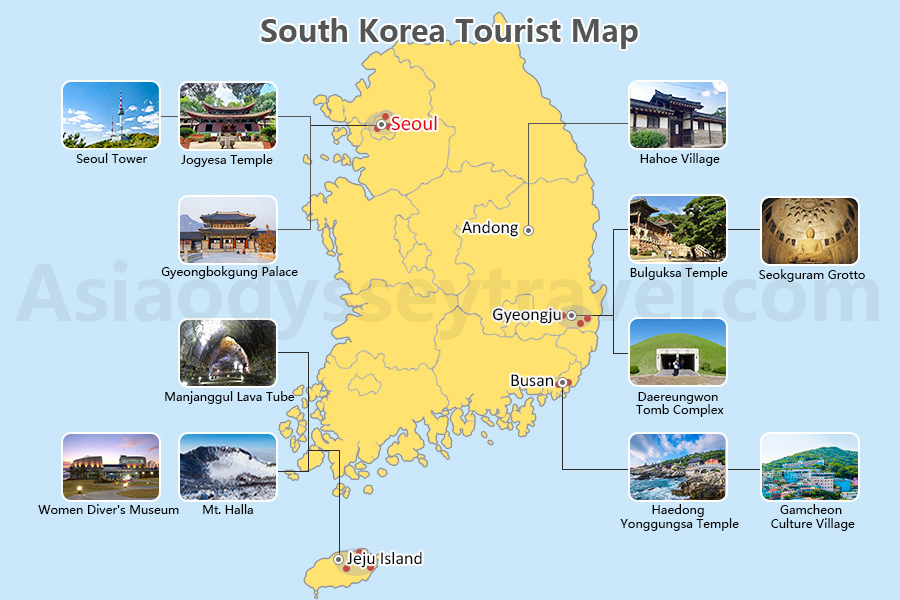
Jeonju is located in the southwest part of South Korea, between Seoul and Busan. It's the capital city of North Jeolla Province.
On the map, you'll see Jeonju sitting inland, not on the coast, surrounded by gentle hills and countryside. This location gives the city a quieter, more traditional atmosphere compared to Korea's coastal cities.
Jeonju is also well connected by express bus and KTX rail, making it an easy stop on a Korea itinerary, especially for travelers moving between Seoul and the southern regions.
Most visitors come to Jeonju as a 1–2 day cultural stop, often combined with Seoul, Busan, or nearby cities like Gwangju.
10 Day South Korea Round Tour: Classic Culture Heritage and Nature Wonders
Seoul - Jeonju - Daegu - Gyeongju - Busan - Andong - Sokcho - Seoul
 10 Days
 8 Places
Jeonju City Map: Layout & Stations
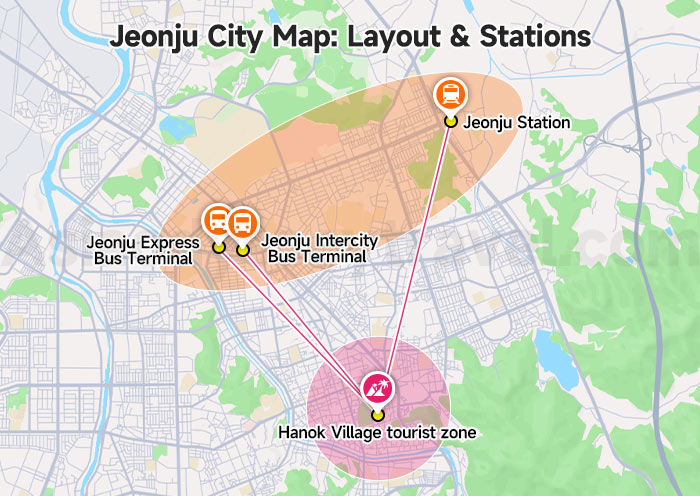
Jeonju is compact, easy to navigate, and very convenient for first-time visitors.
On the map, we divided Jeonju into two main areas: the southern tourist area and the northern transportantion area.
The famous Jeonju Hanok Village, major attractions, and food streets are concentrated in the south, while the city's main stations are located in the north.
If you travel to Jeonju by express bus, you'll probably arrive at either the Jeonju Express Bus Terminal or the Jeonju Intercity Bus Terminal. The two terminals sit very close to each other, within about 100 meters.
If you arrive by KTX train, you'll get off at Jeonju Station, located slightly farther to the northeast.
Together, the station area and the Hanok Village tourist zone form a compact triangle layout, with most major points located within about 3 km of each other.
This is why Jeonju feels much easier to explore than many travelers expect.
In most cases, short taxi rides, local buses, or even walking are enough to move between the station area, food streets, and major attractions.
6 Days South Korea Food Tour: Best K-Food Dishes from Seoul, Jeonju to Busan
Seoul - Jeonju - Gyeongju - Busan
Jeonju Hanok Village Map: Tourist Attractions in Jeonju
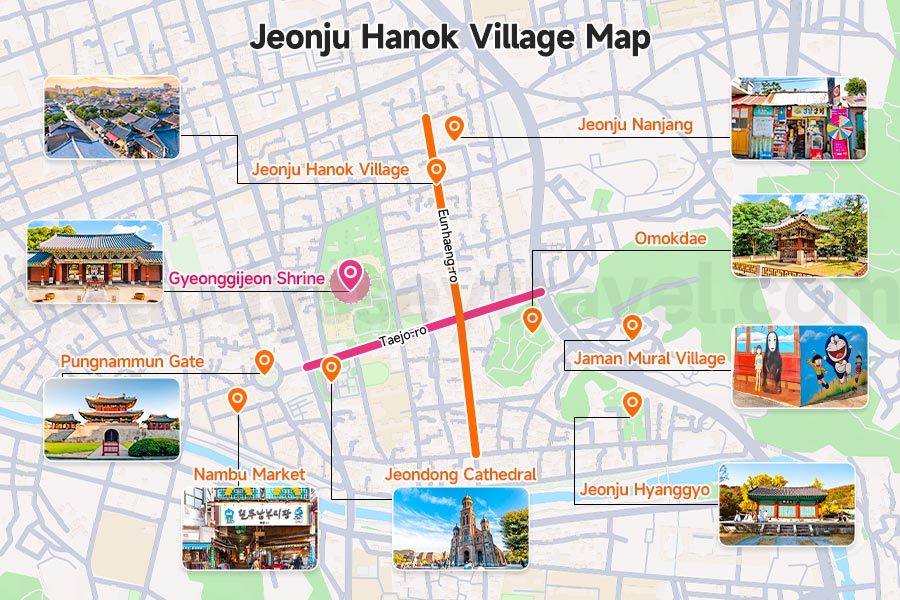
The heart of Jeonju is the famous Jeonju Hanok Village, where traditional houses, historic landmarks, cafés, food alleys, and walking streets are all concentrated within a compact area.
Unlike many tourist cities, Jeonju is best explored slowly on foot. You won't get lost with this Jeonju Hanok Village Map.
Most attractions are connected by walkable streets and small alleys, making the entire area feel like one large cultural neighborhood rather than separate sightseeing spots.
Main Attractions on the Map
For better understanding, we set Gyeonggijeon Shrine as the central point of the Jeonju Hanok Village area.
From here, most major attractions are within a comfortable walking distance, making it easy to explore the entire area on foot without needing transport.
| Attraction | Walking Distance from Shrine | Highlights |
|---|---|---|
| Jeonju Hanok Village | ~3–5 mins | Main traditional hanok district |
| Jeondong Cathedral | ~2–3 mins | Iconic cathedral at Hanok Village entrance |
| Pungnammun Gate | ~5–7 mins | Historic city gate landmark |
| Jeonju Nanjang | ~8–10 mins | Retro cultural street experience |
| Jeonju Hyanggyo | ~12–15 mins | Quiet traditional Confucian school area |
| Omokdae | ~12–15 mins | Hilltop viewpoint over hanok rooftops |
| Jaman Mural Village | ~15–20 mins | Colorful mural village on hillside |
| Nambu Market | ~5–8 mins | Famous local food and night market |
Taejo-ro is the main entrance street with hanok gates, shops, cafés . This is where you naturally enter the Hanok Village area.
Eunhaeng-ro is a Café street with hanbok rental zone. You'll slow down here for photos, cafés, and hanbok experience.
- The Hanok Village is fully walkable and does not require public transport inside the area.
- Most visitors spend 2–4 hours exploring, but staying overnight gives a completely different atmosphere.
- Early morning and evening are the best times for walking and photography.
- Don't forget to explore small alleys to discover traditional hanok stays, cafés, and Bibimbap.
Jeonju Hotel Map: Best Areas to Stay
Staying overnight in Jeonju is highly recommended. In fact, Jeonju is not just a day-trip city — it's one of those places where you'll enjoy it much more if you stay at least one night.
You may want to stay here for different reasons:
- to experience a traditional hanok stay inside Jeonju Hanok Village
- to enjoy more local food and night street atmosphere
- or to use Jeonju as a base to explore nearby attractions like Maisan Mountain and Tapsa Temple
For all these reasons, staying one night in Jeonju makes your trip much more relaxed and complete.
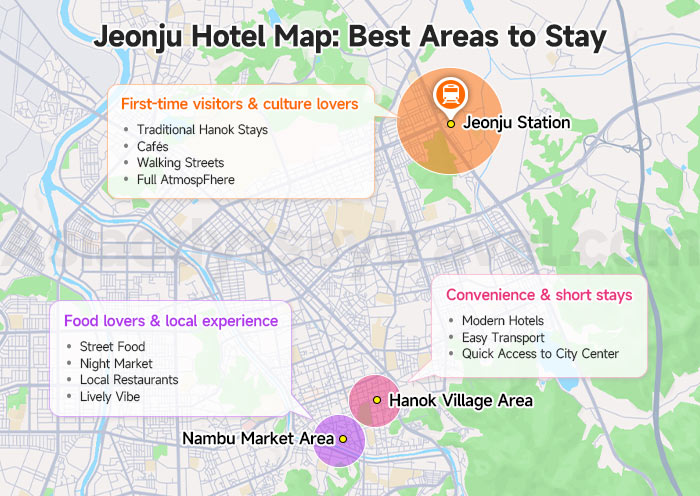
Best Areas to Stay in Jeonju
Once you decide to stay overnight, the next question is simple: where should you stay?
Because Jeonju is compact, your choice mainly depends on travel style rather than distance.
| Area | Best For | What You'll Experience | Stay Style |
|---|---|---|---|
| Hanok Village Area | First-time visitors & culture lovers | Traditional hanok stays, cafés, walking streets, full atmosphere | Most recommended |
| Nambu Market Area | Food lovers & local experience | Street food, night market, local restaurants, lively vibe | Food-focused |
| Jeonju Station Area | Convenience & short stays | Modern hotels, easy transport, quick access to city center | Practical stopover |
- Jeonju is small, so no matter where you stay, everything is still within easy reach.
- Hanok Village is the most atmospheric option, especially for first-time visitors.
- Even a one-night stay will significantly improve your Jeonju experience.
Jeonju Transportation Map: How to Get to Jeonju
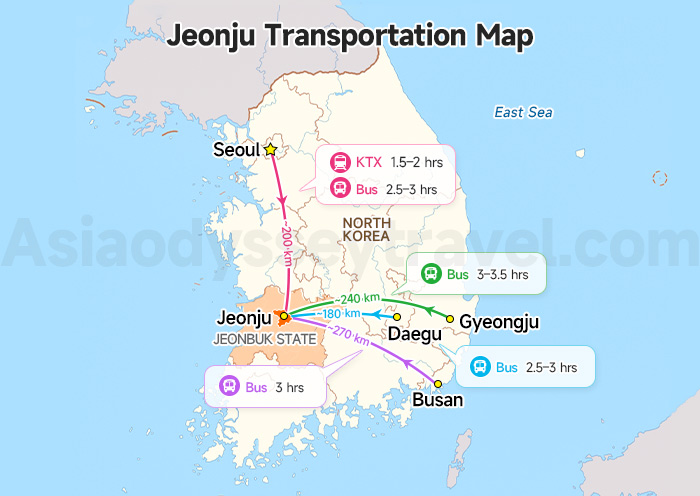
Getting to Jeonju is actually much easier than you might think. Even though it sits inland in the southwest, you can reach it quite smoothly from all major Korean cities.
If you're coming from Seoul, this is the easiest route. You can either take a KTX train (about 2 hours) or an express bus (about 3 hours).
From other popular cities like Busan, Gyeongju, and Daegu, travelers usually rely on direct express buses.
Once your KTX arrives at Jeonju Station, you're already 3 km away from the main tourist area. A taxi ride normally takes around 10 minutes.
If you arrive by express bus, you'll stop near the Jeonju Express Bus Terminal, which is also quite close to the Hanok Village area. In most cases, a taxi ride takes only about 10 minutes as well.
| From City | Distance (Approx.) | KTX Travel Time | Bus Travel Time |
|---|---|---|---|
| Seoul | ~200 km | ~1.5–2 hrs | ~2.5–3 hrs |
| Busan | ~270 km | No Direct KTX | ~3 hrs+ |
| Daegu | ~180 km | No Direct KTX | ~2.5–3 hrs |
| Gyeongju | ~240 km | No Direct KTX | ~3–3.5 hrs |
- Most routes to Jeonju are direct, so you won't need to worry about transfers.
- KTX is only available from Seoul, while other cities mainly rely on express buses.
- All arrivals bring you close to the city center, making onward travel very easy.
Jeonju Day Trip Map: How to Explore Jeonju in One Day
The good news is: Jeonju is actually very easy to explore in one day.
Most attractions are concentrated around Jeonju Hanok Village, so you can mainly travel on foot without rushing too much.
If you take the KTX train from seoul to Jeonju and arrive before 10 AM, you'll have enough time to see the main landmarks, enjoy local food as lunch, walk through hanok alleys, and still catch an evening train or bus back.
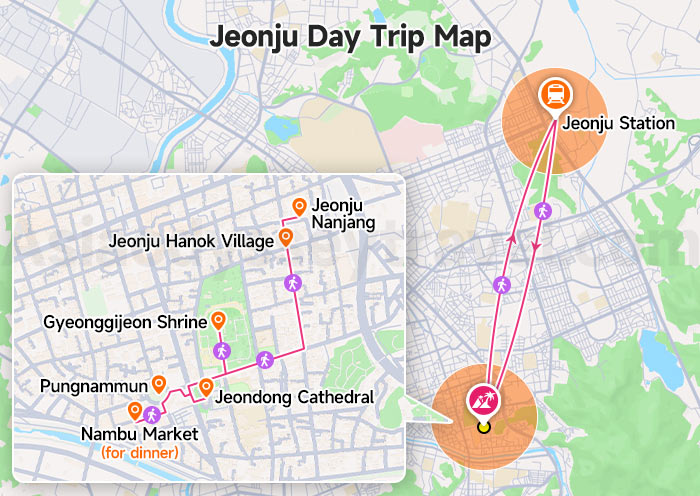
Suggested walking route:
Jeonju Station → Jeonju Nanjang → Hanok Village (for lunch) → Gyeonggijeon → Jeondong Cathedral → Pungnammun Gate → Nambu Market (for dinner) → Jeonju Station
8 Days Western Korea Tour from Seoul to Jeju Island: Capital, Baekje Culture, Volcanic Island
Seoul - DMZ - Gongju - Jeonju - Jeju Island
Travel to Jeonju & South Korea with Asia Odyssey Travel
Getting to Jeonju is easy. With direct KTX trains from Seoul, you can visit as a day trip or short cultural getaway.
The real challenge begins after you arrive.
Jeonju Hanok Village is much larger than you expect. While it's easy to wander, it's not always easy to understand what you're seeing, which buildings are truly significant, or the stories that have shaped Jeonju over the centuries.
And then there's the food.
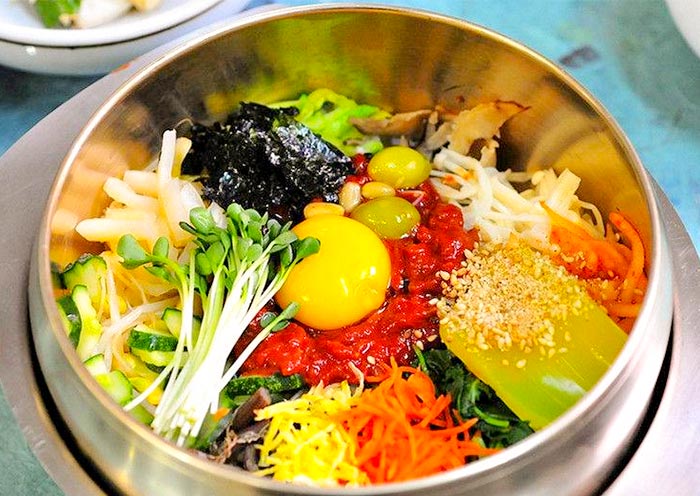
Jeonju is famous as the birthplace of bibimbap, but with countless restaurants claiming to serve the "best" version, how do you know where locals actually go?
That's why Asia Odyssey Travel are here.
Walking through the hanok-lined streets with a knowledgeable local guide—hearing the stories behind the architecture, learning about Jeonju's role in Korean history, and discovering hidden food spots tucked away in side alleys—is a completely different experience.







 Data in submission...